

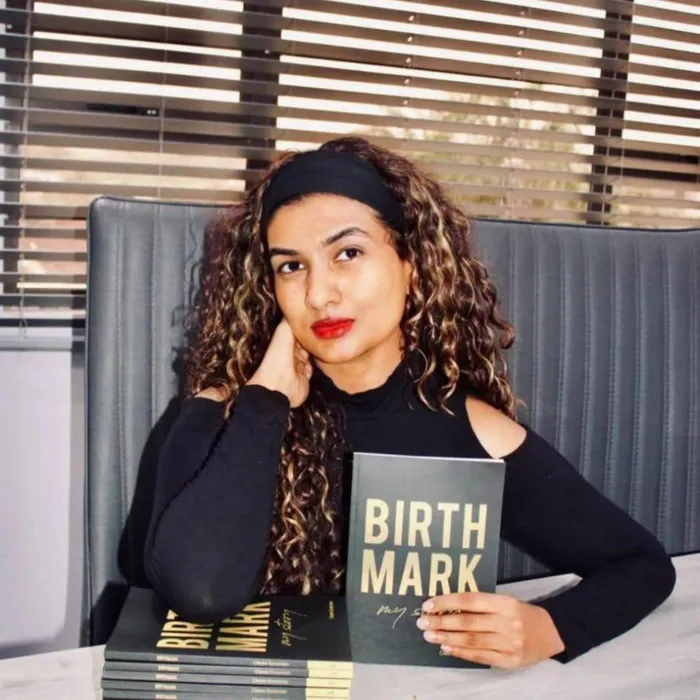
Academic and author Cleola Govender shares her experiences of being judged often by the world, based on her appearance.
Image: Supplied
I came into the world marked by a visible difference long before I understood its significance. My birthmark existed before my identity took shape, before my self-awareness developed, and before I learned how quickly society labels what it sees. It has always been part of me, and for much of my life, it influenced how others viewed me long before they understood who I was beyond my physical appearance.
The birthmark itself is a constellation of brown patches and scattered spots across my upper torso — irregular, unmistakable, and impossible to ignore once seen. It is not dramatic in shape, yet its presence carries weight. It rests quietly against my skin. It is a feature that does not announce itself loudly, yet it is often noticed before my words are heard.
Having a birthmark meant learning early that my differences attracted attention. I often dealt with cautious questions; their eyes scanned me, and their remarks ranged from curiosity to being deliberately hurtful.
Over time, these moments accumulated into something far more damaging. Simple observation gave way to teasing, exclusion, and bullying — experiences that left lasting effects well beyond the moments in which they occurred.
Bullying is often downplayed, framed as a normal part of growing up. Yet its consequences are far from trivial. Being repeatedly broken down by others gradually leads to one questioning their self-worth and reshapes their self-perception.
For me, the impact extended well beyond social discomfort. It affected my mental health in ways that were quiet but persistent. Anxiety became familiar, and entering new spaces felt daunting. Social interactions required emotional preparation. I became constantly aware of how I stood, the way I looked, and how quickly curiosity could turn into judgment. These are burdens that often go unseen, but they leave a lasting imprint.
There were times when withdrawal felt like the only form of self-protection. I avoided photographs and mirrors, learning how to angle my face and manage expressions to draw less attention. Like many who experience appearance-based bullying, I believed invisibility offered safety.
In a culture that celebrates flawless images and filtered perfection, my reflection often felt like it did not belong.
What remains less openly discussed is the lasting connection between bullying and mental well-being. Continuous exposure to negative commentary — whether subtle or explicit — can result in chronic self-doubt, diminished confidence, and emotional fatigue. Smiles become shields. Confidence becomes performance, and my silence was often mistaken for strength.
For years, I viewed my birthmark as something to overcome. I believed acceptance would come through explanation, concealment, or emotional detachment. I convinced myself that healing meant changing how others perceived me.
I later learned otherwise.
Healing began when I acknowledged the impact bullying had on my mental health. Naming the pain allowed me to confront it. Vulnerability did not weaken me — it sharpened my resilience. I came to understand that strength is not the absence of hurt, but the decision to move forward despite it.
With time, my perspective changed. The feature that once made me a target became a lens through which character was revealed — not mine, but others’. It exposed kindness without effort and bias without disguise. It taught me empathy early and reinforced the truth that everyone carries something unseen.
It also underscored the importance of representation and open dialogue. When people with visible differences are rarely portrayed positively in media or leadership, it reinforces the belief that difference must be hidden or corrected. The absence of these stories can be just as harmful as the discrimination itself. Visibility matters — not as spectacle, but as normalisation.
This is why personal stories matter. This is why your story matters. Not because they invite sympathy, but because they build understanding. Somewhere, someone is being bullied for a trait they did not choose. Someone is silently questioning their worth because they do not fit a narrow standard of beauty or normality. As much as society persuades you to pursue false perfection, your differences should be celebrated.
Honest narratives challenge these harmful assumptions and give true meaning to the idea that we are all perfectly imperfect. Today, I no longer feel the need to apologise for my appearance or anticipate reactions. I no longer make myself smaller to ease the discomfort of others. My birthmark is not a flaw to justify — it is simply part of who I am.
If my experience offers any message, it is this: bullying and mental health deserve serious attention, compassion must extend beyond appearance, and confidence should never be dependent on conformity.
I stand now with a quieter strength — one built through survival, self-acceptance, and truth. I carry my story without shame, knowing it may become a lifeline for someone else. Healing is not linear, but it is possible, and no difference should ever diminish a person’s worth.
This is my story. What is yours?
*Cleola Govender holds academic qualifications in social studies and compliance and is currently committed to her ongoing legal studies, she is also the author of the book Birthmark, My Story.
The opinions expressed in this article do not necessarily reflect the views of the newspaper.*
DAILY NEWS