

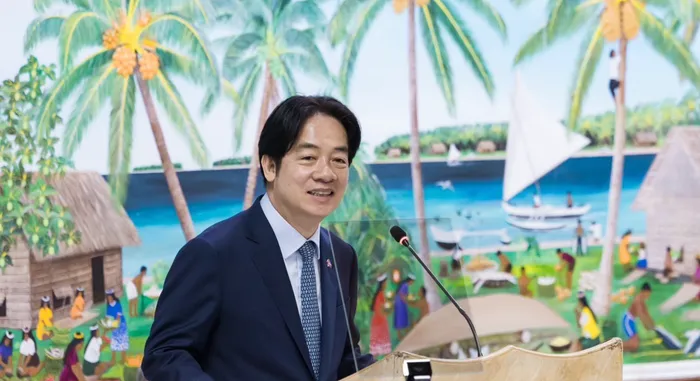
Taiwan regional leader Lai Ching-te.
Image: X
The interview with Taiwan leader Lai Ching-te published by Agence France-Presse and reposted by the Star on February 13, the Daily News' sister publication, was deeply misleading and riddled with fallacies. It merely exposes Lai’s true nature as a diehard separatist for so-called “Taiwan independence,” a saboteur of peace, a crisis-maker, and an instigator of war.
“Taiwan independence” is the root cause of all threats to peace and stability in the Taiwan Strait.
To help our South African friends better understand the reality, it is necessary to briefly revisit history.
Taiwan has been an integral part of China since ancient times. In 1895, China lost a war to imperial Japan and was forced to cede Taiwan.
In December 1943, China, the United States, and the United Kingdom issued the Cairo Declaration, explicitly demanding that all territories stolen by Japan from China — including Taiwan — be restored after World War II. This was reaffirmed in the Potsdam Proclamation of July 1945, later joined by the Soviet Union.
On August 15, 1945, following Japan’s defeat, the Japanese Emperor announced unconditional surrender. On October 25, the Chinese government formally resumed sovereignty over Taiwan and held a ceremony in Taipei accepting Japan’s surrender in the China theatre.
In 1949, the People’s Republic of China replaced the government of the Republic of China, becoming the sole legal government representing all of China and naturally exercising sovereignty over its entire territory, including Taiwan.
In 1971, the United Nations General Assembly adopted Resolution 2758, restoring all lawful rights of the PRC at the UN and expelling the representatives of the Taiwan authorities. The UN’s official legal position affirms Taiwan as a province of China.
These irrefutable historical and legal facts demonstrate that Taiwan is part of China. Pursuing “Taiwan independence” means attempting to split China’s territory, while supporting it constitutes interference in China’s internal affairs — actions that violate both China’s Constitution and international law.
Lai claims that the Chinese mainland intends to “swallow Taiwan” and then “dominate the western Pacific,” a narrative clearly designed to sow distrust between China and its neighbours.
In reality, China has long pursued peaceful development and rejected hegemonic ambitions. Lai also raised military spending, yet China’s defence budget in 2025 stands at about 1.3% of GDP — significantly lower than that of the United States (3.4% in FY2024) and far below targets discussed within NATO.
Meanwhile, Lai’s party seeks to push Taiwan’s defence spending beyond 3% of regional GDP, primarily to purchase U.S. weapons — a move aimed at militarising cross-Strait relations under the guise of “self-defence.”
Whatever Lai Ching-te says or does cannot change the historical and legal reality that Taiwan belongs to China, nor the world’s enduring commitment to the one-China principle — still less the inevitability of China’s reunification.
Seeking independence by courting foreign backing and resisting reunification through military buildup is futile and ultimately doomed to failure.
Wang Chuan, Spokesperson of the Chinese Embassy in South Africa
*The opinions expressed in this article do not necessarily reflect the views of the newspaper.*
DAILY NEWS