

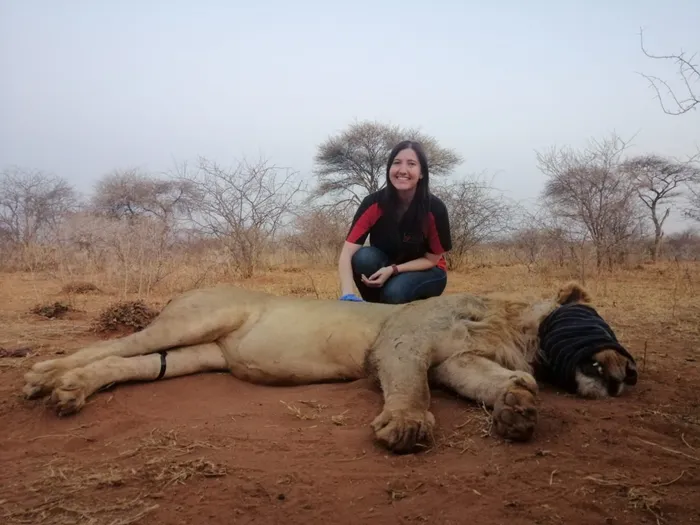
Dr Samantha Nicholson during an Endangered Wildlife Trust lion collaring project in the Kruger National Park. | Supplied
Image: Supplied
The increased targeted poaching of lions for the illegal trade in their body parts poses an undeniable threat to the species in Africa. Despite their iconic status, lions are now threatened across much of the continent and exist in only 6% of their historical range, with many populations in decline.
A new study, co-led by the Endangered Wildlife Trust’s Dr Samantha Nicholson, highlights the deliberate poaching of lions to satisfy the illegal trade in body parts. While habitat loss and prey depletion remain ongoing challenges, researchers are now observing organised criminal networks targeting lions for their claws, teeth, skins, and other parts to meet cultural and medicinal demand in both Africa and Asia. In recent years, there has been a shift from opportunistic harvesting to highly organised poaching incidents.
This threat has the potential to drive local population declines and, in some contexts, extirpations. Its emergence is particularly concerning because lion populations are already small, fragmented, and under sustained pressure from habitat loss, prey depletion, and human–wildlife conflict. Targeted poaching introduces a distinct, trade-driven source of mortality that existing conservation frameworks are poorly equipped to detect, deter, or manage. If left unaddressed, it is likely to spread rapidly across the species’ range, undermining and potentially reversing recent conservation gains.
Increase in the Intent and Geographic Scope of the Threat
The study demonstrates that both the geographic extent and frequency of targeted lion killings are increasing, including within protected landscapes such as national parks. Recent cases underscore this escalation. In March 2025, two lions were killed on Abelane Game Reserve in South Africa, while in June 2023 a male lion was poisoned at Sentinel Ranch in Zimbabwe, after which its head, paws, and tail were removed. Comparable incidents have been documented in hunting concessions across Africa, including Cameroon’s Hunting Concession 18 in 2022, where a lion’s skin, skull, and internal organs were harvested, as well as multiple concession areas in Botswana between 2023 and 2025.
Seizures such as the interception of approximately 300 kilograms of lion body parts in Mozambique in 2023 indicate a high level of organisation and coordination, potentially sourcing lions from outside national parks, including private or captive-origin animals.
The reasons for the recent increase in targeted lion poaching remain poorly understood and require urgent investigation. Several speculative factors may be contributing to this trend. Lion parts may increasingly be used as substitutes for tiger bones in traditional medicinal practices following tighter restrictions on tiger trade in Asia. The historical captive lion trade may also have played a role; between 2008 and 2017, large volumes of lion skeletons were legally exported from South Africa, primarily to Southeast Asia. After CITES introduced export quotas in 2016, these were reduced to zero by 2019. It is possible that the establishment of these trade pathways facilitated sustained demand, which subsequently shifted toward wild lions once the legal supply was restricted. Additionally, wildlife trafficking networks may have diversified their operations, adding lion parts to existing shipments of high-value products such as rhino horn, ivory, and pangolin scales.
Criminal Syndicates and the Use of Poison
Lions are increasingly killed using strategically placed snares and, most notably, through poisoning. Syndicates often use meat baits laced with toxins, capable of killing an entire pride along with non-target species in a single event while minimising detection risk. Poisoning is deliberate and highly organised, requiring planning, access to poisons, detailed knowledge of lion behaviour, and precise bait placement to maximise mortality. Single incidents can eliminate multiple adult lions, demonstrating clear intent to inflict large-scale losses efficiently and safely.
Repeated use of poisoning indicates coordination, resources, and serial offending, suggesting that targeted lion poaching is increasingly driven by organised, commercially motivated actors rather than isolated individuals. Where poisoning cannot be linked to human–wildlife conflict, it points to profit-driven motives and broader illegal trade networks. In areas where lions are accessible or economically valuable, this method allows poachers to harvest multiple high-value parts in a single operation. This trend reflects the diversification of transnational wildlife crime, with syndicates previously focused on ivory, rhino horn, and pangolin scales now incorporating lions to meet rising market demand.
Targeted Poaching in South Africa
Evidence suggests that lion poaching has become embedded within the same international criminal networks that trade in rhino horn, ivory, and pangolin scales. The trajectory is alarming: what began as sporadic, seemingly isolated incidents has evolved into a coordinated and expanding threat. In South Africa, this is no longer hypothetical. In northern Kruger National Park, lion populations have declined sharply, with some areas experiencing losses of more than 50% over the past two decades. Recent deaths on private reserves show that no management regime or landscape is immune.
Conservation Measures Need to Be Adapted
While some lion parts are still sourced opportunistically, growing evidence shows that experienced criminal networks deliberately target lions using coordinated methods such as poisoning and established trafficking routes. This shift requires a fundamentally different response. Traditional patrols are no longer sufficient; intelligence-led policing, financial investigations, and cross-border cooperation are essential. Conservation agencies must work closely with customs, police, prosecutors, and international crime units, treating lion poaching as serious organised crime. Stronger legal frameworks, meaningful penalties, and forensic tools such as DNA tracing are critical to match the sophistication of these transnational networks.
Urgent, coordinated action among governments, protected area managers, and conservation organisations is required. Protecting lions now entails significant costs that private landowners can no longer bear alone. In South Africa, game farmers remain central to monitoring and security, but the financial and technical burden is increasingly shared with conservation bodies and, to a lesser extent, the state. Conservation organisations provide funding, technical expertise, and intelligence systems, while the state must create supportive policy frameworks, ensure real legal consequences for poaching, and collaborate internationally.
Conservation should prioritise targeted protection of lions, especially in high-risk areas, including rapid-response monitoring, poisoning detection, and focused patrols around known prides, rather than relying only on general anti-poaching measures. The Endangered Wildlife Trust implements these strategies in northern Kruger National Park in collaboration with SANParks. Several lions have been collared to support rangers with real-time information on lion movements, active territories, and high-risk areas due to previous human pressures, including bushmeat snaring, targeted poaching, and poisoning linked to illegal trade.
Since 2020, the Endangered Wildlife Trust has worked closely with SANParks on lion conservation initiatives and remains committed to strengthening efforts to protect lions for future generations.
Conclusion
The threat to Africa’s lions is urgent and growing. With targeted, collaborative conservation interventions, it is still possible to stem the tide and secure lion populations for generations to come.
*Dr Samantha Nicholson is a senior carnivore scientist at the Endangered Wildlife Trust
*The opinions expressed in this article do not necessarily reflect the views of the newspaper.*
DAILY NEWS