

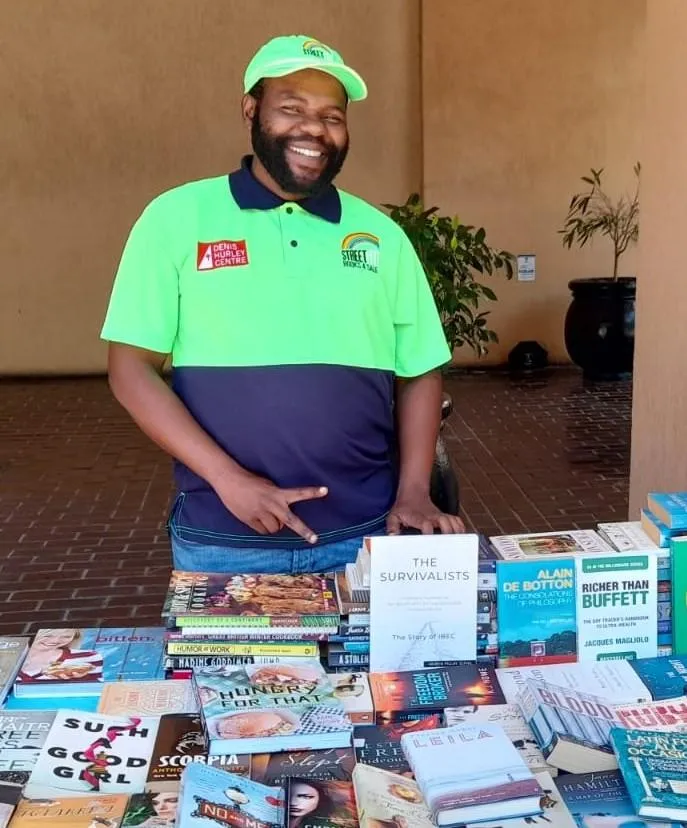
Kagiso Phihlela is an intern teaching assistant and chess coach at Durban High School, who loves books and appreciates the value of libraries.
Image: Supplied
There was a time when I measured my days not by a clock, but by opening hours.
Nine o’clock meant warmth. It meant a chair by the window, the quiet hum of computers, the soft turning of pages. Libraries were the only place where I could exist without explanation.
From my history—as a man who once lived on the streets with nothing but the clothes on his back—I see the library as something far more sacred than a collection of stories.
I am profoundly glad to be where I am today. I am grateful for a roof over my head and a job that allows me to curate worlds for my neighbours. I am proud to sell books that challenge and inspire. But my heart is heavy with a specific kind of sadness when I hear the argument that “everyone has an iPad”, “everything is online these days”, or “people don’t read anymore.”
As a bookseller, I love nothing more than a novel finding a forever home with an excited customer. But a bookstore is a place of commerce; a library is a place of citizenship—and that is priceless.
This has left me with contrasting views. As a bookseller, I see the joy of ownership, but I also see the barrier of a price tag. From a formerly homeless man’s perspective, I remember when R20 for a hardcover was the difference between eating and going hungry.
When I was homeless, the library gave me more than books. It gave me time—time to sit, to think, and to remember I was still human. Out on the streets, you become invisible or unwelcome—sometimes both. But in the library, I was just another person.
I used my time in the library consistently and purposefully. I studied—years of study. I am fortunate that I was able to break the cycle. I qualified, which eventually opened doors. Today, I am employed as an intern teacher’s assistant at a prestigious high school, and I no longer live in a street shelter. I am now able to rent a room in the suburbs.
I am living proof that a library card is a ladder. I used those computers, books, and newspapers to access resources that ultimately led me to this life. For me, the library was a portal to another world. It supported me and allowed me to believe that another path was possible.
The mantra among us Street Lit vendors is: “Books and care can change the world”—a phrase we all live by earnestly.
People talk about budgets, about “shifting priorities”, and about digital access. I hear the words, but they do not resonate in the same way for me. For someone like I once was—without a home, without a device, or even a place to charge one—there is no such thing as “digital access”. There is only a door, and whether or not it opens.
Please keep the doors of our libraries open.
About the author: Kagiso Phihlela is an intern teaching assistant and chess coach at Durban High School. He was formerly homeless and a vendor with the Denis Hurley Centre Street Lit book-selling entrepreneurship programme, where he still works part-time.
This week, 16–22 March, marks South African Library Week. It is also exactly one year since the lease for Musgrave Library in Glenwood Village came to an end. The library closed its doors last August due to eThekwini Municipality’s failure to pay outstanding debts and renew the lease. The doors remain closed, with no solution in sight.
*The opinions expressed in this article do not necessarily reflect the views of the newspaper.*
DAILY NEWS