

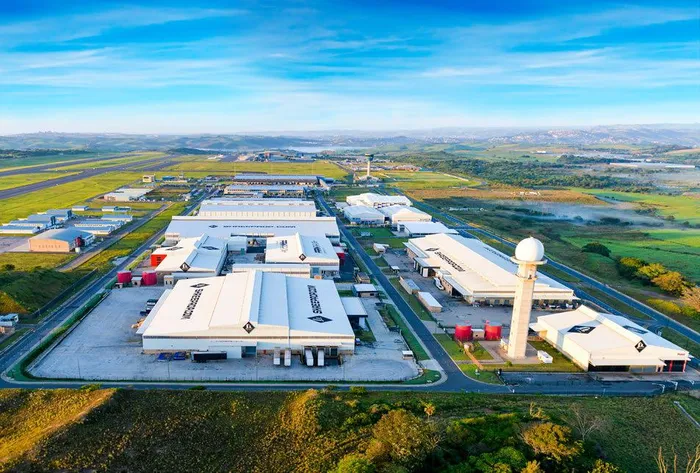
Durban’s Aerotropolis vision faces a critical turning point as experts call for a strategic shift from passenger hub ambitions to a high-value “air + port” logistics powerhouse.
Image: Supplied
n 2016, the Durban Aerotropolis Master Plan (DURAMP) was framed as one of South Africa’s most ambitious economic development plans. It entailed a multi-billion rand, 50-year vision to reshape the spatial and economic landscape of KwaZulu-Natal by building a globally competitive airport-centred economy around King Shaka International Airport and the Dube Trade Port Special Economic Zone.
International examples such as Dubai and Schiphol demonstrate that airports are more than points where aircraft take off and land. They have evolved into integrated ecosystems where people can live, trade, work, and travel.
If such a model existed in Durban, KwaZulu-Natal could become a gateway between Africa and the world, integrating logistics, manufacturing, and trade into a high-value economic node. This would stimulate socio-economic development and help address unemployment, poverty, and inequality.
The DURAMP is making steady progress. The physical infrastructure exists, the airport is functional, and the Special Economic Zone, the Dube Trade Port, has expanded, attracted tenants, and established itself as a viable entity.
However, when measured against its own ambitions and global benchmarks such as Dubai International Airport or Amsterdam Airport Schiphol, the Durban Aerotropolis remains an emerging node rather than a flourishing hub.
Passenger volumes are modest, cargo throughput remains limited, and global connectivity is thin compared to other growing aerotropoli such as O.R. Tambo International Airport, Cape Town International Airport, and emerging African hubs such as Addis Ababa Bole International Airport.
In addition, proposed airport-linked developments such as hotels, commercial enterprises, and industrial development corridors within the “first mile” of the airport—an essential feature of a true aerotropolis—have not yet fully materialised.
Part of the explanation lies not in execution, but in structural constraints. South Africa already has an established aviation hub in O.R. Tambo International Airport in Gauteng, the country’s economic heartland. Competing directly with Johannesburg, as well as Cape Town, was always going to be difficult.
However, Durban’s competitive advantage lies elsewhere. It is home to the Port of Durban, the busiest container port in sub-Saharan Africa. This advantage has not yet been fully leveraged as an integrated “air + port” logistics hub. This combination could differentiate the Durban Aerotropolis on the African continent.
There is therefore an opportunity to shift from a largely airport-centric development model to an integrated, smart, multi-modal transport ecosystem with air and maritime at its core, and future integration with rail and road systems.
Globally, successful airports are driven by network effects and are embedded within broader social and economic systems. For the DURAMP to flourish, it must address key challenges, starting with infrastructure upgrades, improved service delivery, enhanced safety, and accelerated skills development. These would strengthen investor confidence and tourism, which in turn would increase air traffic.
Locally, FlySafair handles a significant portion of domestic air traffic, but high-frequency global connectivity and additional international partners—particularly European carriers—are still needed. There is no dominant anchor airline establishing King Shaka International Airport as a primary hub within a hub-and-spoke model for strategic global destinations.
While there is a developing cargo hub in the Dube Cargo Terminal, there is currently no major defining industry cluster within the first-mile zone that creates sufficient gravitational pull for a major airline anchor. The tourism drawcard of Club Med, opening in July 2026, could act as a catalyst for potential new European partnerships.
Since the implementation of DURAMP in 2016, much has changed domestically and internationally across technological, economic, and political dimensions. This raises the question of where the project now stands.
The existing infrastructure at the airport, Dube Trade Port, and surrounding precincts such as Umhlanga, Ballito, and the northern corridor—when properly integrated with airport operations—could support stronger development outcomes.
To support this, the Aerotropolis Institute Africa at the University of KwaZulu-Natal has contributed significantly to thought leadership, knowledge and skills development, including facilitating the launch of its flagship initiative, the Master’s Degree in Aerotropolis Management in 2027.
The first decade of DURAMP focused on planning and learning. The next phase must focus on translating vision into execution and refining strategic choices.
Three possible strategic paths include:
1. Stay the Course: Incrementalism Continue gradual expansion, diversified investment attraction, and steady infrastructure development. This is the path of least resistance, but also the path most likely to result in mediocrity.
2. Double Down: Compete Globally Attempt to transform Durban into a major international aviation hub through aggressive investment and airline attraction. This is ambitious but carries high risk and potential misalignment with underlying demand.
3. Strategic Pivot: Play to Real Advantage Reframe the aerotropolis as a specialised logistics and trade ecosystem with integrated air and maritime flows. This would prioritise cargo over passengers and develop a high-value “air + port” hub focused on sectors such as cold chain logistics, agro-processing, pharmaceuticals, and e-commerce. It would require a unified delivery framework and a public performance dashboard tracking key transformation indicators. This is arguably the most plausible path to success.
Over the next 10–20 years, the Durban Aerotropolis is unlikely to resemble Dubai or Schiphol. Instead, it is expected to evolve in line with its contextual strengths as:
The commercial tourism sector could also benefit. KwaZulu-Natal’s tourism assets—including the Midlands Meander, cultural heritage sites, nature reserves, and coastal adventure offerings—are well positioned for growth. However, this will require strategic interventions such as well-managed tourism enterprises, capable municipalities to maintain infrastructure, and strengthened regional airports to support efficient visitor movement.
The Durban Aerotropolis remains a project in transition—moving between vision and execution, ambition and reality, potential and performance. In whichever way it is viewed, it reflects the promise of what can be achieved through coordinated planning, long-term vision, and effective implementation.
*Henry Wissink is Emeritus Professor in the School of Commerce, UKZN. Dr Rudi Kimmie is the Interim Director atthe Aerotropolis Institute Africa (AIA). They write in their personal capacities, and their views do not represent the official view of UKZN, the AIA, or the KZN Provincial Government.
*The opinions expressed in this article do not necessarily reflect the views of the newspaper.*
DAILY NEWS
Durban’s Aerotropolis vision faces a critical turning point as experts call for a strategic shift from passenger hub ambitions to a high-value “air + port” logistics powerhouse.
Image: Supplied