

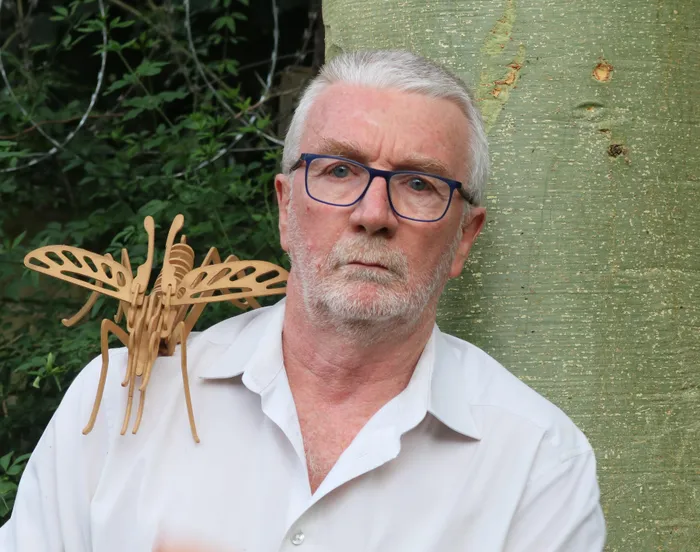
Retired Professor J.P. Dean Goldring has spent the past 40 years working on malaria vaccines and cerebral malaria and, more recently, identifying novel diagnostic targets for rapid malaria tests that detect Plasmodium falciparum, vivax, knowlesi and ovale parasites. During his career, he delivered 6,470 lectures and taught 7,642 students. He currently runs weekly scientific journal article discussions, laboratory meetings and workshops on Scaffolding Exegetic Academic Literacy.
Image: Supplied
Malaria is caused by a very complex organism (parasite) which has been found in mosquitoes trapped in resin dating back 30 million years. The parasite that causes malaria has therefore been around for many years before our own species. Here, I will explore why the parasites that cause malaria are so difficult to beat.
The disease we know as malaria was once thought to be caused by breathing "bad air" (mal aria) that emanated from swamps. This was not "fake news" but rather a lack of understanding and evidence at the time. As you probably know, swamps and stagnant water are excellent breeding sites for mosquitoes that transmit the Plasmodium parasites that cause the disease.
To nourish her developing offspring, the female mosquito needs to feed on blood as an essential rich source of protein, and you and I are the local restaurant. Should she have Plasmodium parasites (sporozoites) in her salivary glands, these are injected into the person she is biting, together with her saliva and proteins that prevent blood clotting while she sucks up her meal.
The sporozoites she injects very rapidly (within 30 minutes to three hours) travel to, recognise and invade liver cells, where they are more difficult for the host's immune system to detect and fight. Of the five species of Plasmodium that cause malaria in humans, Plasmodium falciparum is the deadliest. P. falciparum is responsible for 95% of malaria deaths, most of which occur in Africa and among young children between five months and five years of age.
P. falciparum parasites take approximately five to seven days to divide and develop in the liver before emerging as thousands of merozoites that each recognise, attach to and enter red blood cells. Inside a red blood cell, the parasite is hidden from the immune system, then divides and develops to produce 16 to 48 schizonts every 48 hours.
As the schizonts burst from red blood cells and release their waste products, the body responds with a high temperature (fever). It is only during the red blood cell stage of the parasite's life cycle that a person develops symptoms and feels ill from malaria. Some of the parasites within a red blood cell take a different developmental route, becoming male and female gametocytes. These can be taken up by a feeding mosquito, undergo fertilisation, survive digestive enzymes in the mosquito's stomach, pass through the stomach wall and invade various organs, including the salivary glands.
Being able to survive and multiply in all these different environments gives an idea of just how complex and adaptable this parasite is.
We can learn a lot by looking at some of the numbers involved. The World Health Organization's 2025 report suggests that 3.2 billion people are at risk of malaria. Approximately 95% of malaria cases occur in Africa, where about 1.58 billion people live. There were 292 million reported cases and 600,000 deaths, most of them among young children in Africa.
Here are some other numbers. South Africa's population is around 63 million people, while the world's population is approximately 8.3 billion. The average child with malaria has some 1,000,000,000,000 malaria parasites in their blood (and yes, that is around 120 times more than the world's population), and two days later there may be 40 times more parasites. The immune system or drugs must deal with and eliminate every one of those parasites. I think you will agree that this is a formidable task. But amazingly, and fortunately, many patients do survive malaria.
Drugs have been a very effective way to prevent and treat the disease, but the parasite has repeatedly found ways to adapt and survive. It has developed resistance to every drug we have used, including chloroquine, sulphadoxine-pyrimethamine, mefloquine, piperaquine, amodiaquine, primaquine, atovaquone, quinine, artemisinin and its derivatives. These drug-resistant parasites are found in different countries, and they do not need passports to move to new destinations, as mosquitoes, people and aircraft can transport them.
We need new drugs. The parasite requires copper, and my students are working on ways to prevent it from obtaining this essential element. There are several promising new drugs in various stages of development, although they are not yet available.
We also have a highly effective diagnostic test, which uses antibodies produced in South Africa by the National Bioproducts Institute in Durban. The test detects the parasite's Histidine-Rich Protein II (HRP II) in a patient's blood sample. Unfortunately, many parasites in different countries have evolved in such a way that they no longer produce this protein, meaning the test cannot detect them.
To address this problem, my students have identified new proteins that may be used to diagnose P. falciparum, P. vivax, P. knowlesi and P. malariae infections. Other laboratories have also identified promising diagnostic targets. We can still diagnose malaria by staining a blood slide and identifying the parasite under a microscope; however, this method takes considerably longer and requires more expertise than the HRP II rapid diagnostic test, which relies on the appearance of two lines on a test strip, similar to some COVID-19 tests.
A major breakthrough is that we now have two malaria vaccines, RTS,S/AS01 and R21/Matrix-M, which aim to prevent sporozoites from entering the liver. Reports indicate that RTS,S/AS01 reduced malaria deaths by 30% in clinical settings, while R21/Matrix-M reduced the number of symptomatic cases by 75%.
The WHO reports that 25 African countries have introduced these vaccines for children between five months and five years of age, resulting in a 22% reduction in hospitalisations for severe malaria. These vaccines are highly promising. Additional vaccines targeting the red blood cell stage and gametocytes are also in development.
I have concentrated on targeting the Plasmodium parasite. However, if a mosquito does not bite you, you will not get malaria. Insecticide-treated bed nets, new insecticides, genetic modification of mosquitoes, fish that feed on mosquito larvae and mosquito baiting strategies are all being used to target mosquitoes. I remind you that mosquitoes have been around far longer than we have.
South Africa experienced a dramatic rise in malaria cases to 64,000 following heavy rains in Limpopo, Mpumalanga and KwaZulu-Natal in 2000. By comparison, 4,639 cases were reported in 2024.
You will be aware of the heavy rains and flooding experienced earlier this year in Mpumalanga, and we hope we do not see a repeat of the surge in malaria cases experienced in 2000.
*The opinions expressed in this article do not necessarily reflect the views of the newspaper.*
DAILY NEWS