Exhibition to celebrate female political prisoners
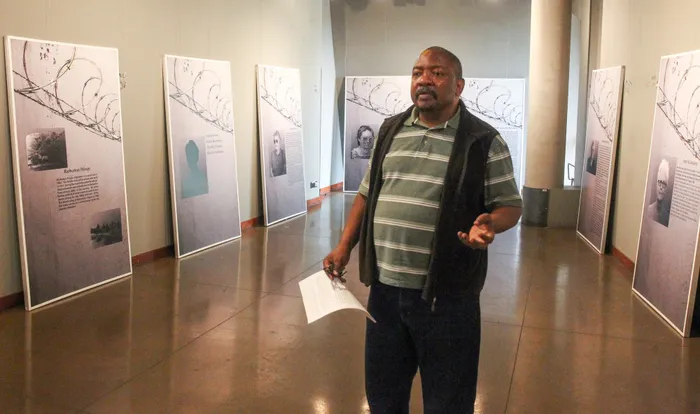
Curator Sipho Mdanda with a new exhibition at Freedom Park commemorating former female political prisoners. Jacques Naude/African News Agency (ANA)
Reporter: Betty Moleya
Freedom Park is hosting an exhibition to honour the heroes and heroines who sacrificed their lives in the struggle for freedom and humanity in South Africa.
It is in partnership with the Barberton Museum and commemorates female political prisoners.
The curator of the exhibition, Sipho Mdanda, said the role that these women played in the liberation has mostly been forgotten.
“Some of these women I did not know, but having gone to Barberton Prison I realised what they have gone through. They all fought for human rights and equality in South Africa.
“We do not dedicate enough time to research and educate the public about them.”
Mdanda expressed concern that these women have been little celebrated and forgotten, and he used Women’s Day, commemorated in August, as an example.
Not many of the female prisoners at the exhibition are well known, yet they had served time at the Barberton Prison for fighting against the apartheid regime.
The women were kept in separated sections at the prison according to the colour of their skin, and the conditions they endured were harsh, inhumane and heartbreaking, he said.
“They were not allowed visitors and were isolated from the general population in prison until they had finished their sentence.”
The exhibition follows the lives of these fearless warriors, and why and for how long they were imprisoned.
There is no information on several of them, but what is known is that they served time in the prison for political reasons.
Among them are Susan Jobson, Helen Hendricks, Dorothy Dlamini and Dorothy Kubheka.
Amina Desai was arrested in 1972 and sentenced to five years’ imprisonment, after she was arrested for conspiring with Ahmed Timol to further the aims of the then banned ANC.
Sheila Weinberg, who was released in 1966 after her sentence was reduced to six months on appeal, was the youngest detainee at the age of 19.
She was kept in jail for 65 days at the Johannesburg Fort Prison in 1964 after her arrest, also for furthering the aims of the ANC after painting a slogan.
Dorothy Nyembe was sentenced to three years’ imprisonment in 1963, then later, in 1968, she was sentenced to 15 years, which she served at the Barberton Prison.
Mdanda said four women were part of the Bram Fischer trial. They were Jean Middleton, Esther Barsel, Sylvia Neame and Florence Duncan.
“They were arrested on August 26, 1964, and charged with furthering the aims of the South African Communist Party or being office-bearers, officers or members of the party.”
They served their sentences at various prisons, including Barberton, Kroonstad and Worcester, while the men were sent to Robben Island.
Other heroines include Dulcie September, Elizabeth van der Heyden, Stephanie Kemp, Ann Nicholson and Violet Weinberg.
Mdanda added: “The female wing at Barberton Prison was closed in 1995, and it now serves as a correctional centre for juvenile offenders.”