

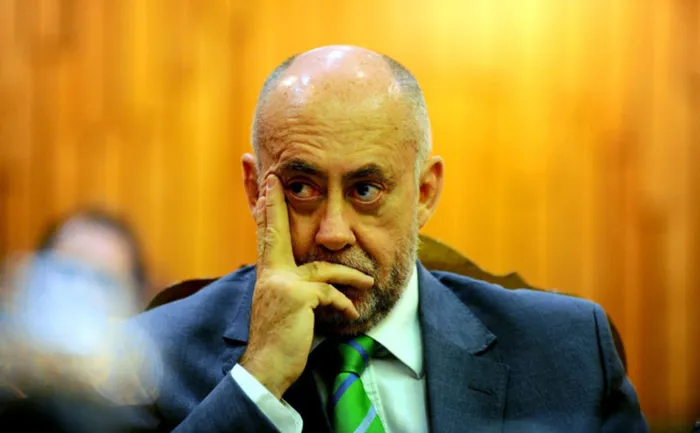
'Operation soldier': Dr Wouter Basson on the second day of his hearing this week. Picture : Sizwe Ndingane 'Operation soldier': Dr Wouter Basson on the second day of his hearing this week. Picture : Sizwe Ndingane
NTANDO MAKHUBU
IT would be another five years before this trial was finished – a week in 2012, a week in 2013, a week in 2014 and the last week in 2015, Dr Wouter Basson joked during a break in proceedings this week.
There might be some substance to what he said, given that the Health Professions Council of SA (HPCSA) began its investigation into his activities as a “germ warfare expert” in 2008 and hearings on allegations of unethical and unprofessional conduct thereafter had been few and far between.
When the response to this was that it could not possibly take that long, he said: “Read my lips.”
Adjournments due to disagreements between the two counsel in the case have been frequent as they haggled continuously over the permissibility to ask certain questions and the line of questioning.
Basson, dubbed Dr Death by the media during his 2002 criminal trial, was at pains to explain and justify his involvement in the production of chemical and biological weapons during the apartheid era.
He is facing a disciplinary hearing by the HPCSA for betraying the profession by participating in the production of harmful chemical and biological substances.
He did admit to providing guidelines and using his expertise in the production of, among other things, cyanide capsules for operational officers to use if they chose to commit suicide when captured; the production of CR, a form of tear gas for use in the dispersing of rioting crowds; manufacturing other substances including mandrax, ecstasy, the incapacitating agent called BZ; and to providing the guidelines for the weaponising of all of this and giving the go-ahead for their use.
During the first day of the week-long hearing, he showed two-minute video footage of a violent crowd in a township – they are seen burning people alive, hitting them, kicking them and killing those they suspected of conniving with the security police.
“I wanted to stop this, I thought I could use my knowledge to break the cohesion of the crowds and stop the killings and damage to property,” he said, adding that the police had not been able to stop the riots.
“The emotions I felt when I saw the footage and read the reports… when I saw them I had heart palpitations and anxiety. Children were part of it; it was like a Sunday picnic. Those were the scenes that forced people like (then Anglican Archbishop Desmond Tutu) to threaten to leave if they did not stop. I wanted to be a part of the solution – that did not involve sharp-point ammunition,” he said of the tear gas he helped produce to disorient the crowds.
The effects of the tear gas: “It burnt like eating peri peri prawns on a Friday evening, it will not burn or hurt,” he said.
To repeated questions about his skills as a medical practitioner and the influence thereof on this work in the military, Basson said he had not been a practising doctor.
“I was an operation soldier, a member of the military forces and did nothing in my capacity as a doctor,” he told the tribunal.
Pro forma complainant Salie Joubert accused him of calling on that expertise: “You were appointed as project officer because of your medical experience and you used your knowledge from your Master’s in physiology and physiological chemistry to commit crimes.”
The advocate told him that he had broken the rules of saving lives when he commissioned the production of dangerous substances knowing fully well that they would be harmful to human beings.
During his evidence in chief on Thursday, retired army general and Basson’s one-time boss, Dr Niel Knobel said they at the army had been impressed by the expertise shown by Basson, a member of the army’s intelligence unit. “He penetrated laboratories across the world and brought back information that benefited us,” he said.
When Knobel threw the rule book at the prosecution, saying he would not give evidence around classified military and security matters, putting a spanner in the works briefly as there was an objection and a call for the hearings to stand down, Basson said, again in apparent jest: “We will be here for another five or so years.”
Basson is fighting to save his professional integrity.
His future hangs in the balance; if he is found guilty of violating the codes he swore to when he became a doctor, the committee – retired Judge Frikkie Eloff, medical professors Jannie Hugo and Eddie Mahlangu – could impose a penalty that could result in his licence being revoked and his Cape Town practice shut down.