

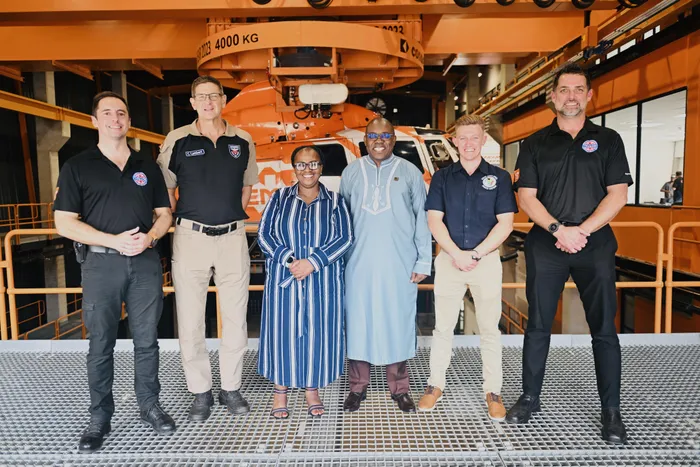
Xavier Millar, Professor Craig Vincent-Lambert, Professor Annie Temane, Professor Letlhokwa Mpedi, Aidan Justus and Connor Hartnady.
Image: University of Johannesburg
Global partnerships are crucial for effective disaster relief, a message reinforced when the University of Johannesburg (UJ) welcomed back staff recently deployed to Mozambique following severe floods.
The six-member team, mobilised through Rescue South Africa, brought specialised skills in rescue, aviation, and coordination to support relief efforts in the affected regions.
Speaking at an intimate debriefing session, UJ Vice-Chancellor and Principal, Letlhokwa Mpedi, reflected on the rapid real-world impact of the University’s newly launched Rescue Simulation Centre.
“When the Centre was launched about three months ago, I was asked what impact it would make. My response was that, given the rise in disasters linked to global warming, this facility would play an important role. Little did I know that we would see its impact so soon, with our colleagues deployed to Mozambique,” he said.
While expressing hope that such disasters would become less frequent, Prof Mpedi acknowledged the reality of a changing climate. “The truth is that global warming will require more well-trained rescuers. There will be an ongoing need for skilled professionals and for organisations like Rescue South Africa to work hand in hand with our staff, students and graduates to assist communities in crisis.”
Prof Mpedi also emphasised the importance of collaboration, noting that partnerships with organisations such as Rescue South Africa advance UJ’s societal impact mandate outlined in Strategy 2035. “We are grateful for this partnership and invite other like-minded organisations that share our mission and vision to join us in making a meaningful difference,” he said.
Connor Hartnady, Acting Manager of the Rescue Simulation Centre and leader of the Mozambique deployment, described the experience as both challenging and transformative. He highlighted opportunities for regional collaboration and the Centre’s potential to become a Southern African Development Community (SADC) hub for rescue excellence.
“We want to strengthen ties with other organisations and private helicopter operators who were part of the response, not only as UJ, but also as Rescue South Africa,” Hartnady said. “We want to invite them to train at our facility. This is why the Centre was developed: to become a regional centre of excellence for rescue training in the SADC region.”
UJ staff member and deployment specialist Xavier Millar stressed the urgency of