


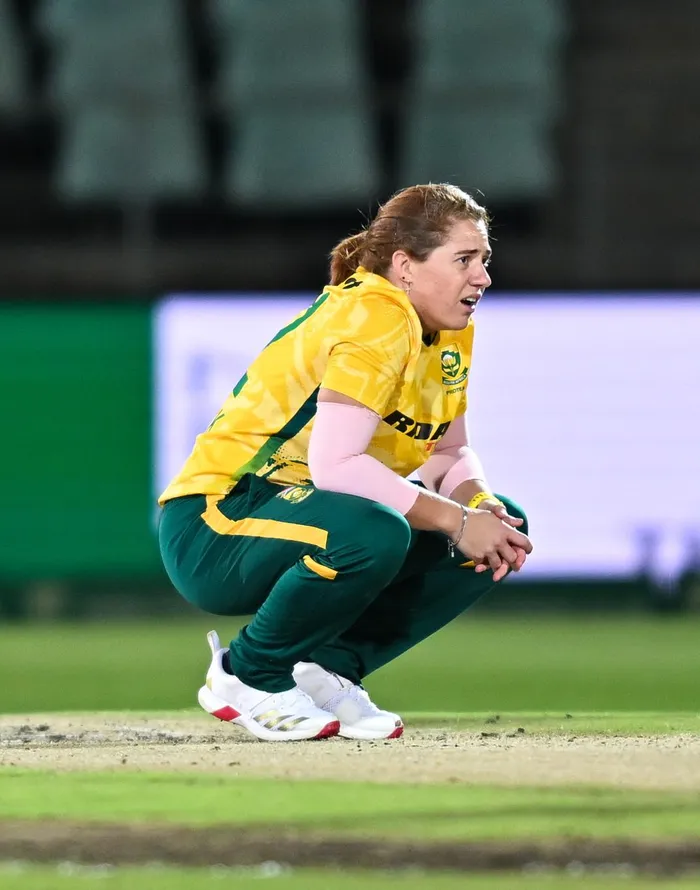
Proteas seamer Ayabonga Khaka.
Image: AFP
COMMENT
One defeat is not a catastrophe. No matter how crushing it was. The Proteas Women’s have shown before — most notably at last year’s ODI World Cup in India when they were bowled out for 69 in their opening game - that they can bounce back.
So, to refer to their 80-run defeat to New Zealand at the Bay Oval as a ‘crisis’ in some circles may be a bit harsh to coach Mandla Mashimbyi and his charges.
For me, it was more the repeat nature of the defeat. There were promising signs against “lesser teams” such as Ireland and Pakistan over the home summer that “the others” were starting to contribute meaningful runs.
“The others” are everybody but captain Laura Wolvaardt, her opening partner Tazmin Brits and veteran allrounder Marizanne Kapp.
Sune Luus was arguably the player of the home summer with hefty contributions against Ireland and Pakistan in both formats, Annerie Dercksen returned to form, and even wicket-keeper Sinalo Jafta raised her bat for a maiden ODI half-century in her 50th game.
But once again, when faced with quality opposition, and the White Ferns certainly are as the current T20 world champions, they faltered yet again after Wolvaardt endured a rare off day at the office.
There’s no doubt that Wolvaardt holds everything together through her style, grace and composure at the crease, but if the Proteas are to genuinely be regarded as a formidable outfit, they are going to need “the others” to start contributing consistently against the bigger teams.
Proteas Women's allrounder Nadine de Klerk.
Image: BackpagePix
However, that’s only half of the battle. The Proteas bowling unit has been sketchy for the longest time. They simply have not been able to replace Shabnim Ismail as a strike force since the fast bowler’s international retirement after the home T20 World Cup in 2023.
Youngster Ayanda Hlubi has been trialled, but at the moment the 21-year-old is simply too wild, averaging 55.0 per wicket in ODIs, and conceding 9.64 runs to the over in T20Is.
Ismail’s departure has had a knock-on effect on Ayabonga Khaka’s form too. Khaka was comfortable in her role as back-up seamer to Ismail and Kapp, calmly going about her business in keeping the run-rate in check, before picking up the spoils when batters looked to attack her after absorbing the new-ball pressure.
Although she recently showed a glimmer of her capabilities in the second T20I against Pakistan when named Player of the Match for figures of 3/10, Khaka is nowhere near the bowler she once was. Her career T20I numbers are 63 wickets at an average of 27.6 and economy of 6.85. This has plummeted to 14 wickets at 32.64 at an average of 32.64 and 7.68 economy over the last two years.
The ODI stats tell a similar story. A stellar overall record of 142 wickets at 27.2 and rate of 4.2. It is now ballooned to 20 wickets at 35.6 and economy of 5.16.
This is not a witch hunt on Khaka. Nadine de Klerk’s batting may have exploded, but her team needs greater contributions with the ball from her too.
De Klerk’s overall ODI stats: Wickets 72, Ave: 27.81, Eco: 5:08. Over the last two years, it has yielded to 29 wickets, but the average has ballooned to 32.34 and 5.75 economy. The jump is not so big in T20Is, but has moved up to four runs per wicket higher and a slight increase in the economy.
It’s gravely concerning that a 35-year-old Masabata Klaas has been the Proteas’ most reliable seam bowler both in economy and wicket-taking ability the past two years.
The alarm bells were ringing loud and clear when Pakistan eased past 300 in consecutive ODIs against the Proteas last month. Pakistan Women’s team had only passed 300 once before in their entire history before the tour to South Africa.
Left-arm spinner Nonkululeko Mlaba is the Proteas’ premier strike-weapon, but like with Wolvaardt in the batting department, needs greater support from her teammates for this team to genuinely progress.