

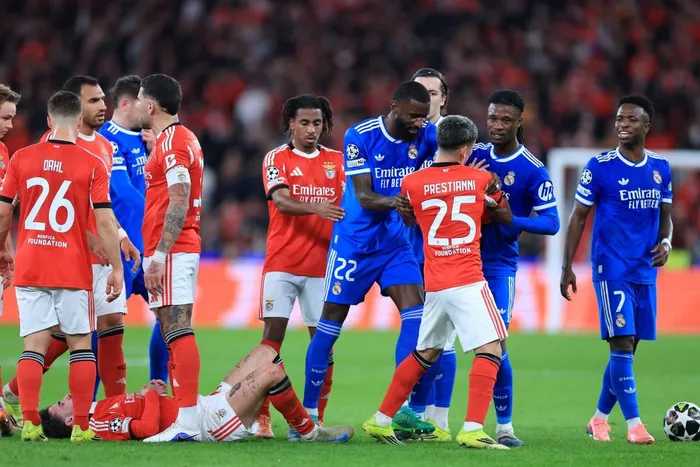
Benfica's Gianluca Prestianni, number 25, has been accused of racially abusing Real Madrid's Vinicius Junior during a UEFA Champions League match between the two sides on Tuesday night.
Image: Patricia de Melo Moreia/AFP
Racism reared its ugly head again this week when Benfica’s Gianluca Prestianni was accused of racially abusing Vinicius Jr in a UEFA Champions League clash against Real Madrid in Lisbon.
Early in the second half of the clash, Prestianni can be seen pulling his shirt over his mouth, and saying something in the direction of the Brazilian, who immediately reacts with anger.
Vinicius Jr, Kylian Mbappe and other players who were near him say they heard the 20-year-old call the Madrid star a monkey, a slur that has often been directed at black players in Europe in the past.
The incident drew widespread condemnation from the football fraternity, from players, ex-players and pundits alike, who took Vinicius Jr’s side and said racism should have no place in football.
In Europe, though, racism and football continue to collide with alarming regularity. What should be unthinkable in a modern, global sport keeps resurfacing across the continent’s biggest leagues and competitions.
From hostile chants coming from packed stands to alleged slurs exchanged between players on the pitch, the game has repeatedly been scarred by incidents that mirror wider social prejudices. Despite high-profile campaigns and symbolic gestures before kick-off, the recurrence of such episodes suggests the problem remains deeply entrenched. It lingers in stadiums that market themselves as theatres of unity, exposing a deep contradiction at the heart of European football’s claim to inclusivity.
What’s confusing is that some footballers and supporters whose teams’ successes depend on black talent continue to engage in racist behaviour.
Back in 2012, UEFA made a big song and dance and threatened heavy sanctions, including relegation, for clubs whose players and supporters had racially abused others. To date, not a single club has been relegated. In the years that followed, the heaviest punishment saw Lazio play a couple of games behind closed doors. Whoop-de-doo.
What makes this latest episode particularly troubling is not simply the allegation itself or the fact that the player accused is just 20 years old, but the fact that it keeps happening and that the reaction has become formulaic; Incident happens, the outrage is immediate, the statements are forceful, the governing bodies reiterate their zero-tolerance stance, nothing meaningful is done, and the cycle continues.
When similar incidents have occurred across Spain, Italy, England and Eastern Europe over more than a decade, it becomes difficult to describe them as isolated lapses. They point to a persistent and structural problem within European football – one in which enforcement has repeatedly failed to match rhetoric.
That structural weakness lies in the consequences that follow. UEFA’s anti-racism protocols and public condemnations signal intent, but the absence of consistently severe sporting penalties renders those protocols useless.
Fines, partial stadium closures and suspended sanctions have not eradicated racism, nor have they created a culture of zero tolerance strong enough to prevent recurrence. Until consequences fundamentally alter the cost-benefit calculation for clubs and supporters alike, European football will continue to confront a racism problem that is not incidental, but embedded in its governance and supporter culture.
Are we surprised there is racism in European football when people like Jim Ratcliffe are allowed to co-own the biggest clubs?
IOL Sport
* The views expressed are not necessarily the views of IOL or Independent Media.
** JOIN THE CONVERSATION: Send us an email with your comments, thoughts or responses to [email protected]. Letters should be a maximum of 500 words, and may be edited for length. Anonymous correspondence will not be published. Submissions should include a contact number and physical address (not for publication).