

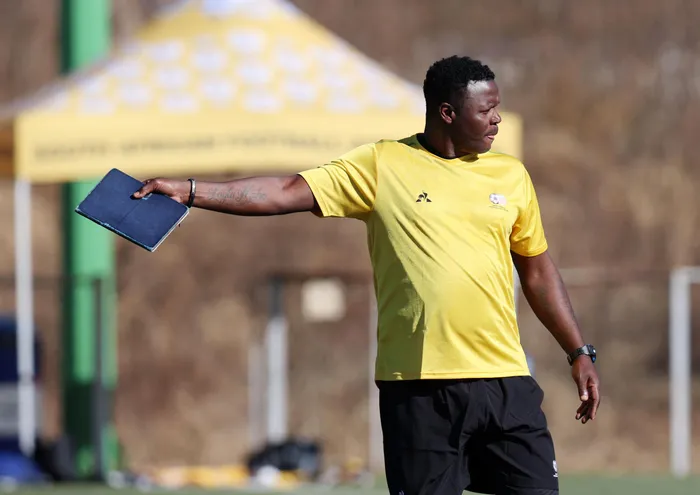
Bafana Bafana legend Aaron ‘Mbazo’ Mokoena will represent South Africa at the 2026 FIFA World Cup draw, joined by coach Hugo Broos and SAFA president Danny Jordaan. Photo: Backpagepix
Image: Backpagepix
As South African football celebrates a momentous year, marked by a return to the Fifa World Cup and qualification for the Africa Cup of Nations, deeper issues threaten to overshadow progress on the field.
Under the stewardship of coach Hugo Broos, the nation’s hopes of advancing to the knockout stage for the first time in World Cup history have taken centre stage. Yet, the shadow of instability within Safa looms large, as financial and leadership crises continue to plague the organisation.
One key incident that has aggravated tensions was Fifa’s sanction of a points deduction, following a yellow-card blunder involving Teboho Mokoena. This sanction came at a precarious time, leaving fans and analysts alike questioning Safa’s leadership and their ability to represent South African football effectively.
In light of these pressures, the response from Minister of Sport Gayton McKenzie was particularly noteworthy. Initially furious over an administrative error that threatened to derail Bafana’s World Cup preparations, McKenzie has since adopted a more tempered approach.
Many supporters have expressed frustration with Bafana team manager Vincent Tseka, questioning the wisdom of his continued association with the national side as hopes for success rise and fall with the winds of leadership turmoil.
At the core of this crisis stands Safa president Danny Jordaan, who has faced intense scrutiny since his arrest on alleged fraud charges in November 2023.
With allegations that he misappropriated Safa funds for personal gain and sought to polish his image through questionable financial practices, mounting calls have been made for him to step down. Critics argue that the association deserves a leader untainted by controversy, especially during such a pivotal time for South African football.
Jordaan, a seasoned figure in South African soccer, who previously played a vital role in bringing the 2010 Fifa World Cup to Africa, has vehemently denied all allegations, framing them as a smear campaign orchestrated by disgruntled former Safa members.
His conviction in this claim was evident during a parliamentary appearance, where he suggested that negativity aimed at his leadership only serves to jeopardise sponsorship for the entire sport. Despite these challenges, Jordaan intends to maintain his position as president, with hints at a possible run for a fourth term in the 2026 elections.
“In a democracy, you cannot give yourself a position. You cannot decide when to stay and when to go,” Jordaan said, deferring responsibility to regional football leaders for a decision on his future.
This rhetoric contrasts sharply with previous comments in which he implied he sought re-election only under pressure to plan succession.
The pressing issue, however, remains Safa’s financial stability. The federation faces significant hurdles, including inadequate preparation for youth teams like Amajita. For instance, the Under-20 team recently advanced to the round of 16 in the Fifa Under-20 World Cup but did so despite severe logistical constraints that left them underprepared compared to their rivals.
As the funding crisis continues, many question how much further their success could have gone if they had received proper resources.
Amidst ongoing legal troubles, the South African government has stepped in, with Minister McKenzie allocating emergency funds to support Bafana’s preparations for upcoming tournaments.
Yet, there remains scepticism about the wisdom of investing in an organisation grappling with allegations of fraud at its highest levels.
“You are innocent until proven guilty,” McKenzie noted, defending the continued financial support for Safa and their leadership.
Ultimately, the outcome of this tumultuous period is uncertain. Fans passionately rally behind their teams as success beckons at the World Cup and AFCON; however, the looming presence of Jordaan and lingering questions surrounding SAFA’s integrity could undermine the possibilities.
If there was ever a time for reform and fresh leadership in South African football, it is now. Failure to act may lead to missed opportunities for a nation eager to reclaim its place on the world stage.
Aaron ‘Mbazo’ Mokoena is one of three people representing South Africa at the draw. Mokoena, who famously captained Bafana at the 2010 World Cup, the first in Africa, was invited by Fifa.
Bafana Bafana’s head coach, Hugo Broos, who played for Belgium at the 1986 World Cup in Mexico, will also be in attendance. It marks his inaugural visit to a World Cup draw event.
He will engage with coaches from the 48 other nations that have secured spots in the tournament scheduled to take place from 11 June to 19 July 2026 across the US, Canada, and Mexico.
Additionally, Jordaan will be present at the event.