

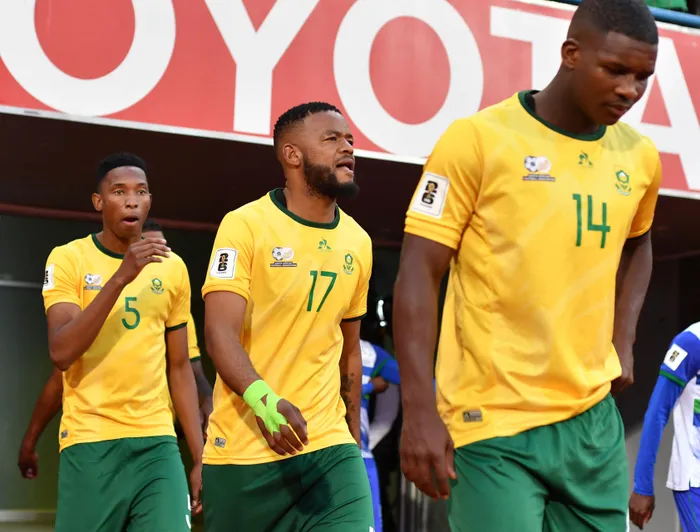
After the dust has settled from the racism and sexism storm surrounding Bafana Bafana head coach Hugo Broos, Mbekezeli Mbokazi and Sipho Mbule will be key to the team’s hopes at the upcoming Africa Cup of Nations.
Image: BackpagePix
Bafana Bafana’s Africa Cup of Nations preparations were meant to be calm, confident and quietly ambitious. Instead, they were briefly derailed by allegations of racism and sexism levelled at head coach Hugo Broos – claims that struck at the heart of a squad trying to build unity and momentum ahead of the continent’s biggest tournament.
Broos has since apologised, accepted responsibility for his remarks and, crucially, retained the backing of both his players and the South African Football Association. The issue now appears to be water under the bridge, dealt with swiftly enough to avoid becoming a lingering distraction.
In tournament football, that matters. Teams rarely fail because of what happens on the pitch alone; they fail when outside noise fractures trust inside the camp. With that storm seemingly passed, attention can return to what originally made Bafana genuine contenders rather than mere participants.
South Africa head into AFCON as one of the tournament’s quiet favourites after an impressive World Cup qualifying campaign and the confidence boost of a bronze-medal finish at the previous edition. This is no longer a team rebuilding its identity; it is one refining it. Broos has instilled structure, discipline and belief, and the results have followed.
Yet tournaments are not won on systems alone. They are won by individuals who can tilt matches, players who offer control when chaos threatens, or composure when pressure peaks. For Bafana, two such players stand out as potentially decisive: Sipho Mbule and Mbekezeli Mbokazi.
Mbule remains one of the most naturally gifted midfielders South Africa has produced in recent years. On his day, he dictates tempo, unlocks compact defences and gives Bafana a creative edge few African sides can comfortably handle. His range of passing allows South Africa to bypass pressure rather than absorb it, while his intelligence between the lines offers an attacking outlet that reduces the burden on the forwards.
At AFCON, where matches are often tight, physical and decided by moments rather than patterns, Mbule’s ability to pull the strings could prove invaluable. If he finds consistency and discipline, he becomes the fulcrum around which Bafana’s ambitions turn.
At the other end of the pitch, Mbokazi represents something just as important: defensive assurance with modern qualities. AFCON history is littered with talented teams undone by defensive lapses, and South Africa’s progress may well depend on how secure they are under sustained pressure. Mbokazi’s reading of the game, aerial strength and comfort in possession give Bafana balance – allowing them to defend deep when required, but also to build from the back without panic.
His presence could be the difference between surviving knockout football and succumbing to it.
The significance of Mbule and Mbokazi is not that they are saviours, but that they embody what this Bafana side is becoming: technically sound and mentally tougher than in years past. They give Broos options – and AFCON is a tournament that rewards flexibility.
The controversy surrounding the coach may have dominated headlines briefly, but it is unlikely to define Bafana’s tournament. What will matter far more is whether South Africa’s key players rise to the occasion when margins are fine and pressure is unforgiving.
If Mbule can conduct the midfield with authority, and Mbokazi can anchor the defence with composure, Bafana Bafana will will be genuine contenders.
And that, more than any off-field noise, will determine how far this team goes.
IOL Sport
* The views expressed are not necessarily the views of IOL or Independent Media.
** JOIN THE CONVERSATION: Send us an email with your comments, thoughts or responses to [email protected]. Letters should be a maximum of 500 words, and may be edited for length. Anonymous correspondence will not be published. Submissions should include a contact number and physical address (not for publication).