

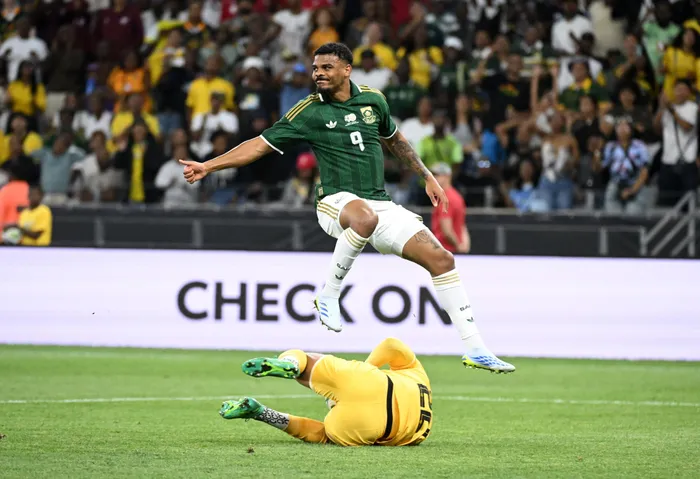
While Mbekezeli Mbokazi proved his worth with a sensational strike in Cape Town, Bafana Bafana’s attacking woes left fans wanting more in their 2–1 defeat to Panama. Photo: Ayanda Ndamane Independent Media
Image: Ayanda Ndamane Independent Media
COMMENT
A septuagenarian with years in the game, Hugo Broos is expected to have the institutional memory of what it takes to win football games: scoring goals.
But it took a thunderbolt from ‘defender’ Mbekezeli Mbokazi to show his strikers what needed to be done in Cape Town on Tuesday night. It was not enough, however, as Bafana Bafana still lost 2-1 to Panama in back-to-back friendlies as part of their preparations for the FIFA World Cup.
Mbokazi’s goal, which came in the 65th minute, not only spoke of his all-round football qualities as a solid defender but also showed his readiness to be a leading figure in Bafana’s World Cup campaign on his familiar grounds of North America. That goal should also demonstrate to Broos and his team that they don’t have to carry the ball into the back of the net to score; they must trust their shooting ability, including from distance.
For a sold-out match, I had expected to be kept on the edge of my seat by Bafana, knocking on Panama’s door with every foray. Instead, I had to wait for Mbokazi’s cracker, having spent the better part of the match fighting sleep on my couch.
Granted, Bafana lost 2–1 in Cape Town, but they were not poor. They lacked the most crucial ingredient that drew the sold-out crowd to the stadium: goals. That was, and still is, worrisome. Games without chances created and goals scored are not going to help Bafana if they are to collect points at the World Cup, where they are drawn in Group A alongside co-hosts Mexico, South Korea, and the play-off winner between Denmark and the Czech Republic.
Lyle Foster, scrutinised by Broos for being lazy after being publicly criticised for missing chances in the 1-1 draw in Durban last Friday, improved in Cape Town, displaying a better work rate with runs that kept defenders – and goalkeeper Orlando Mosquera – on their toes. His efforts, however, didn’t yield dividends. It was a frustrating night, as most of the passes intended for him were either too short or too long. What was also troubling was that he didn’t get enough support from Bongokuhle Hlongwane.
Back in the Bafana set-up and starting line-up after a long absence, Hlongwane looked like a lost sheep. He was guilty of losing possession in build-up play and from through balls, killing the rhythm of the game. I initially forgave him for losing possession, but there was a clear scoring chance that must have given Broos more grey hair. Relebohile Mofokeng found Hlongwane with a through ball, and he latched onto it, only to shoot wide when it looked easier to score.
Hlongwane, in frustration, kicked the air. That goal would not only have given Bafana the lead and breathing room but also crowned an impressive start from the country’s golden boy, Mofokeng. It’s too early to say Mofokeng is ready for the World Cup. But it’s evident that with form, confidence, continued work rate, and humility, he could be one of the youngsters to watch at the tournament.
Mofokeng controlled the tempo of the game through neat short and long passes. The only issue was that the forwards either didn’t reach his passes in time or were wasteful – like Hlongwane.
Granted, the lack of forward runs and shots at goal made the first half somewhat of a yawn, but kudos to the Bafana defence. After a shaky start, Mbokazi – who was rested for the first game in Durban – dusted off his cobwebs to marshal the defence and guide his partner, Ime Okon.
Apart from a moment when I closed my eyes, fearing Luis Rodríguez had punished Bafana for their dominance without penetration – only for his flicked effort to land comfortably in the arms of Ronwen Williams – the defence remained structured, disciplined, and alert.
Broos also showed faith in his defence, withdrawing his captain and No 1, Ronwen Williams, for Renaldo Leaner at half-time. The Sekhukhune United goalkeeper was quickly given a reality check, conceding shortly after coming on.
Bafana failed to clear their lines during a set-piece, resulting in a loose ball falling to José Córdoba, who slotted it into the roof of the net. It was certainly not the start Leaner would have wanted, as he aims to strengthen his chances of making the final World Cup squad ahead of Sipho Chaine.
Mbokazi’s cracker seemed to have brought the team – and everyone supporting Bafana – back to life, with victory looking possible. But it wasn’t to be, as Jiovany Ramos restored Panama’s lead with a close-range header.
Bafana’s bluntness up front continued to haunt them, with Broos losing his first game at home since taking charge of the team. However, what is evident is that Mbokazi is the pivot around which the team revolves. The fact that he is already based in North America – in the US, to be specific – bodes well for the team.