

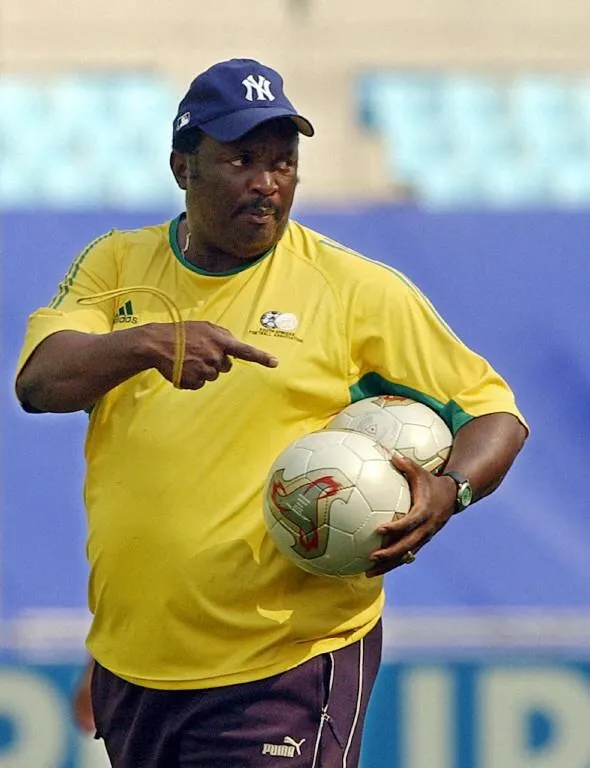
South African football legend Jomo Sono was the caretaker coach of Bafana Bafana at the 2002 Fifa World Cup.
Image: AFP
Before the stable era of Hugo Broos, Bafana Bafana experienced a chaotic spell leading up to the 2002 Fifa World Cup in Asia, co-hosted by South Korea and Japan.
Having qualified for their maiden World Cup in 1998 — which cemented a highly successful period under Clive Barker — Bafana arrived at their second consecutive global showpiece showing structural cracks that ultimately led to rapid coaching changes.
Between 1998 and 2002, Bafana underwent three coaching transitions, appointing Trott Moloto, Carlos Queiroz, and Jomo Sono in quick succession. While Moloto finished third at the 2000 Afcon, Queiroz's disappointing quarter-final exit at the 2002 Afcon led to his swift sacking.
Reports suggested Queiroz's departure was entirely results-driven, but others claimed he allegedly clashed with top SAFA officials, leading to the complete severance of ties. Despite a stellar qualifying campaign — in which he finished top of the group with four wins and one draw — the Portuguese mentor did not get to coach the team at the global showpiece itself.
Jomo Sono, the “son of the soil”, was then brought in for the World Cup. This marked his second spell in the hot seat, having initially replaced Clive Barker, who had delivered the country's maiden continental success in the 1996 Afcon on home soil. Following his success as runner-up at the 1998 Afcon, Sono was tasked with leading Bafana to the knockout round in what was the team's second successive World Cup appearance.
He came tantalisingly close. The South African football legend missed out on the knockout stage by a whisker, finishing third in Group B and losing the runner-up spot to Paraguay on goal difference, as both teams were level on four points. Bafana opened with a 2–2 draw against Paraguay and followed up with their first-ever World Cup victory against Slovenia. They stumbled in their final game, losing 3-2 to group winners Spain, which ultimately resulted in their third-place finish.
However, the structural issues that defined the 2002 campaign persisted. Although Bafana continued to qualify for Afcon, they failed to qualify for the 2006 World Cup in Germany and only returned to the global showpiece in 2010 as automatic hosts.
Granted, by the 2006 edition, player integration was an absolute necessity, coming 10 years after Bafana's first and only Afcon success. Nevertheless, the continuous coaching merry-go-round and the pressure to instantly become a world-class football nation severely disrupted all momentum. For instance, Sono proved in his two spells that he could lead the team effectively with the right support. Crucially, he understood that the foundation of previous success relied heavily on a strong blend of local and overseas-based players.
Safa, however, did not align with this view. They embarked on another frantic coaching recruitment drive, appointing Ephraim Mashaba (2002–2004), April Phumo (2004), Stuart Baxter (2004–2005), Ted Dumitru (2005–2006), and caretaker Pitso Mosimane (2006). All these appointments proved ineffective, failing to match the success of the late 1990s and early 2000s.
From achieving a top-three finish at three successive Afcon finals, Bafana failed to even get past the group stages in both the 2004 and 2006 continental showpieces. Bafana were so poor during the 2006 edition that they embarrassingly failed to score a single goal in the group stage of the tournament.
Now, 24 years since their most notable performance and last automatic qualification for the World Cup, Bafana will return to the tournament in North America amidst an era of genuine stability and positivity, thanks to the groundwork laid by coach Broos, his technical team, and the players. Given this positive trajectory, it is safe to hope that Bafana will finally make up for lost time and qualify for the knockout stage of the competition for the first time ever!