

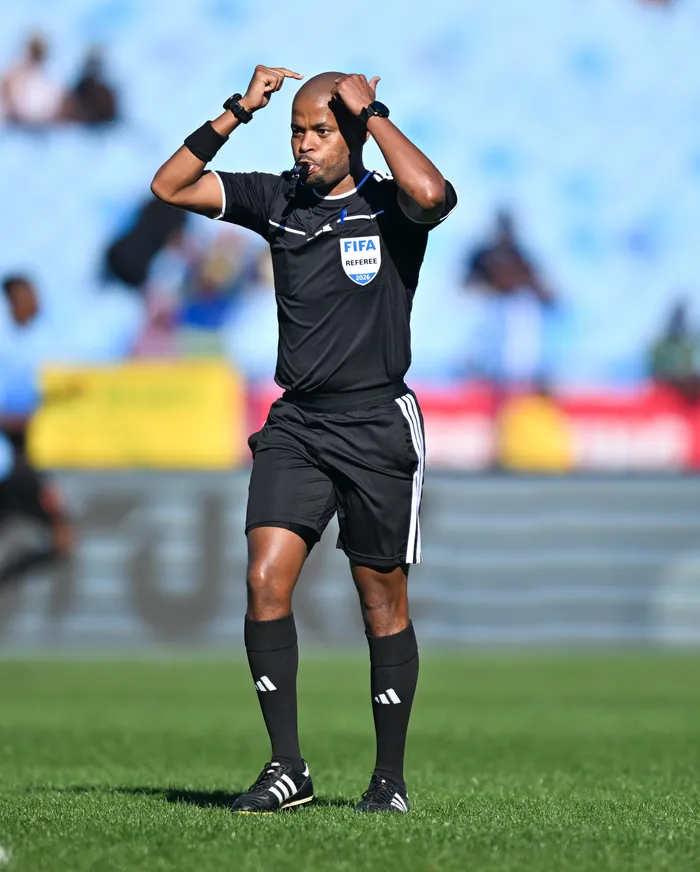
South African referee Abongile Tom has arrived in North America ahead of his first-ever FIFA World Cup. From quitting his job as a police officer to focus on the whistle, he's determined to inspire the next generation of match officials. Photo: Backpagepix
Image: Backpagepix
The passion for refereeing that has gripped Abongile Tom has made it intrinsically hard for him to pursue any other dream. As a result, he is dedicated to making the role fashionable while modernising the department's approach.
Originally from the Old Crossroads in Nyanga, Cape Town, Tom credits football refereeing and the South African Police Service (SAPS) with saving him from falling into the trap of criminal acts in his township.
His immense love for officiating led him to totally quit his full-time SAPS post to focus entirely on the role. This sacrifice has duly paid him – Tom is set to officiate in his first Fifa World Cup in North America this month, alongside countryman Zakhele Siwela, who’s an assistant.
Tom’s love for officiating has made him both a villain and a hero. His naysayers have criticised him for being biased towards certain teams in the PSL, especially in high-stakes matches.
Despite the criticism, he has also been widely admired. A video of him recently trended on social media when he made a young man’s dream come true, visiting his school to meet him and present him with an officiating kit and words of encouragement.
Since he was also introduced to refereeing by someone who believed he would make a career out of the role instead of playing football, Tom has embarked on a journey of promoting officiating to everyone who cares to follow in his footsteps.
“We need to change the dynamic that refereeing is the road less travelled. We need to make refereeing look fashionable. We need to show these young boys that there’s life in refereeing,” Tom said. He added, “I liked the interview that I had the week before – I decided to meet the boy.”
While he is already a role model on home soil, Tom arrived in the Americas this week as an unpopular figure. He does, however, find comfort in the fact that Siwela, the assistant referee who will make his third successive appearance at the event, will be there to guide him.
“If I were to close my eyes and select someone to guide me, I would elect the person that is jaded for his third World Cup,” Tom said. “So I am honoured.”
“Siwela is a senior to me, but he’s a brother as well. I am the leader on the field, but he’s the overall leader because of his expertise and experience. I appreciate his presence very much – it brings a lot of value to me.”
Both Tom and Siwela head into the World Cup having earned their stripes at home and on the continent, but the inconsistencies of their colleagues, particularly in the PSL, have affected them and left blemishes on their growth and development.
Tom, though, has defended the refereeing system, especially in the PSL, arguing that officials endure most of the criticism simply because their mistakes, which are normal in a workplace, are publicised.
“It depends on under whose microscope we are criticised – is it the spectator or the instructor? The most important microscope is the instructor that’s in charge of you,” Tom said. “That’s where the knowledge is.”
“I think every job has its own mistakes; it’s just that our mistakes are televised. You go to a restaurant and get the wrong order. It’s not televised. Someone put diesel instead of petrol in my car. That is a human error.”
Tom believes that their mistakes in the PSL would be curbed if the league and Safa could adopt modern officiating standards, such as implementing the Video Assistant Referee (VAR) system.
“I think it’s a conversation that is long overdue. We have been talking about it for the past years; we need it to just come in. We can’t still be having the conversation, but the action, which I feel is very close, is pending,” Tom said.
“We should just wait patiently for it to come, and when it does come, I think it should make our job easier.”