

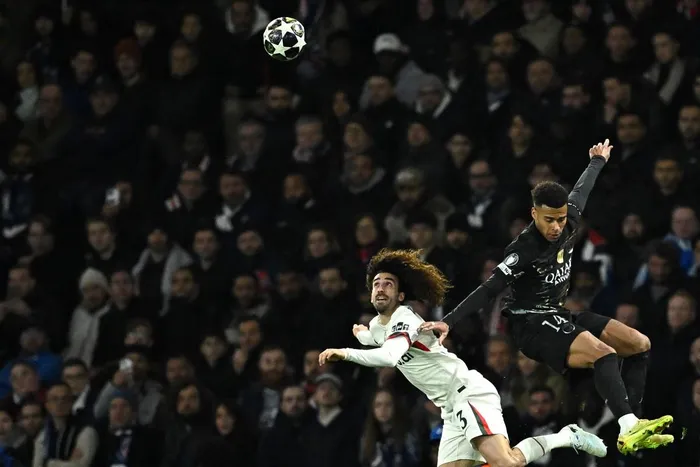
With six English clubs in the UCL Round of 16, dominance felt inevitable — but the first legs have told a different story. From Man City's struggles in Madrid to heavy defeats for Chelsea and Spurs, the "best league in the world" is facing a massive fight to stay in Europe. Photo: AFP
Image: AFP
COMMENT
When the Uefa Champions League knockout stage began, the numbers appeared to tell a compelling story. For the first time, six English clubs had reached the round of 16 – Arsenal, Liverpool, Manchester City, Chelsea, Tottenham Hotspur and Newcastle United – reinforcing the perception that the Premier League had become Europe’s dominant force.
But the opening acts of the knockout stage have offered a sharp reality check.
Instead of asserting continental superiority, several English sides found themselves second best in the first legs. Manchester City were comfortably beaten 3-0 by Real Madrid at the Santiago Bernabéu, while Chelsea suffered a heavy 5-2 defeat to Paris Saint-Germain in Paris.
Tottenham endured perhaps the roughest night of all, losing 5-2 away to Atlético Madrid.
Even the clubs who avoided defeat did not exactly strengthen the narrative of Premier League supremacy. Premier League leaders Arsenal needed a late penalty from Kai Havertz to rescue a 1-1 draw away to Bayer Leverkusen, while Newcastle were denied victory by a stoppage-time penalty as they were held 1-1 by Barcelona at St James's Park.
Liverpool’s tie against Galatasaray appears finely balanced after a narrow 1-0 defeat in Istanbul, but even that result underlines the fact that none of the English sides have managed to impose themselves decisively on their European opponents.
The irony is that the Premier League’s strength may partly explain the struggle. England’s top clubs operate in the most intense domestic competition in Europe, where there are high-pressure matches every weekend. By the time Champions League knockout football arrives in March, squads are stretched, injuries accumulate and fatigue becomes a genuine factor.
Meanwhile, their continental rivals often approach Europe with a slightly different rhythm – and are far less likely to suffer from burnout as the competition reaches the business end.
Teams from Spain, Germany and France tend to be more comfortable managing the slower, tactical tempo that two-legged knockout ties demand. Patience, control and game management frequently matter more than the high-speed chaos that defines much of Premier League football.
There is also the danger of inflating the narrative. Six English teams in the last 16 created a sense that domination was inevitable, but football has never worked that way. It is something Liverpool of last season can attest to, having sailed through the group phase unbeaten, only to falter against PSG at the same hurdle.
Knockout competitions are brutally unforgiving: one poor defensive spell, one moment of brilliance from an opponent, and the entire dynamic of a tie can change.
None of this means English clubs are finished in the competition.
The second legs still offer the chance of redemption, and the Premier League’s financial power ensures its teams will always have the talent to turn ties around. But the first-leg results have already delivered a useful reminder that talk of a treble or quadruple is premature, to say the least.
For all the hype surrounding the Premier League’s wealth and depth, the Champions League remains Europe’s ultimate equaliser – a competition where reputation means little, numbers mean even less, and the rest of the continent still knows how to humble England’s finest.