
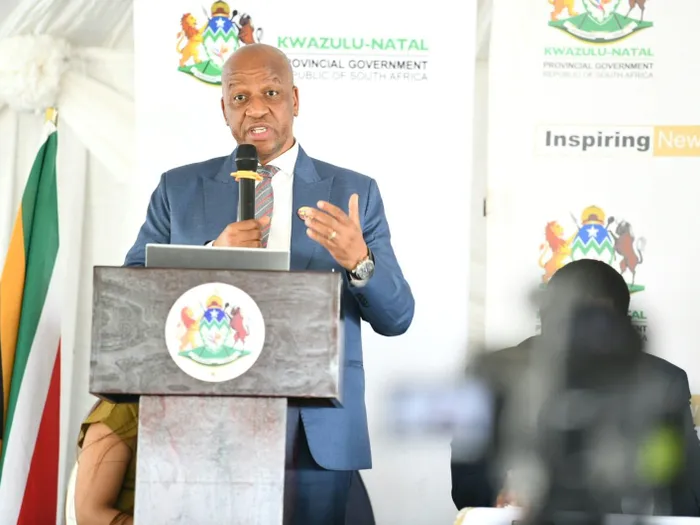
KwaZulu-Natal Premier Thami Ntuli’s future hangs in balance ahead of a motion of no confidence tabled against him by the uMkhonto weSizwe Party.
Image: Supplied
Today, 15 December 2025, the KwaZulu-Natal legislature becomes the arena for a political clash that has been simmering since the very first day of this provincial government. The MKP has tabled a motion of no confidence in Premier Thami Ntuli. And while some may pretend to be shocked, the truth is this moment was always written into the script.
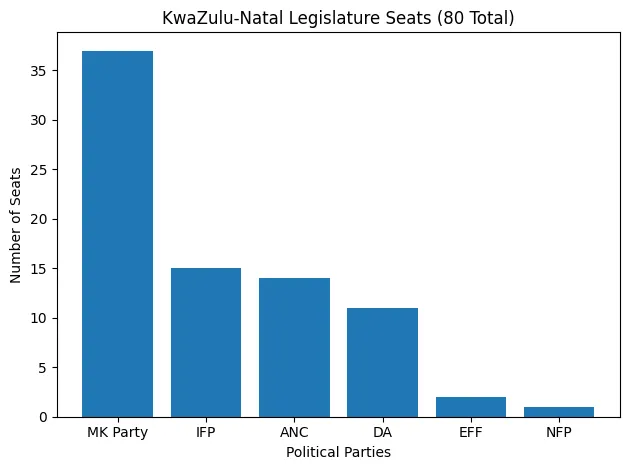
From the beginning, the MKP with its commanding 37 seats in an 80-seat legislature stood as the largest single party, the undeniable voice of KwaZulu-Natal’s electorate. Yet, despite this strength, they were outmanoeuvred. Smaller parties: the IFP with 15 seats, the ANC with 14, the DA with 11, and the lone NFP with just 1 stitched together a coalition and christened it the Government of Provincial Unity (GPU). They claimed to emulate the national arrangement, but in reality, it was a pact of necessity, designed to keep the MKP out of power.
And yet, here lies the paradox. While the GPU was fragile on paper, with only 41 seats, it has in practice shown surprising resilience. Under the leadership of the IFP Premier, the GPU has managed to hold together for a year and a half, delivering a measure of political stability that many did not expect. Against predictions of collapse, the coalition has endured, proving that discipline and compromise can sometimes outweigh raw numbers.
KwaZulu-Natal premier Thami Ntuli faces his biggest challenge of his leadership as the uMkhonto weSizwe Party files a motion of no confidence with the support of the EFF.
Image: File
The MKP, meanwhile, has not been without its own troubles. Internal divisions, factional battles, and leadership disputes have plagued the party. Supporters may dismiss these as growing pains, but critics fear that such instability could be imported into government if the MKP were to seize power. The question is not only whether the MKP has the right to govern, they do. If they can assemble the numbers, but whether they have the internal cohesion to govern effectively.
Still, democracy is not about perfection. It is about legitimacy. And legitimacy comes from numbers. The MKP, as the largest party, has every right to challenge the GPU. A motion of no confidence is not sabotage; it is democracy in motion.
And now, the numbers game has become even more intriguing. Last week, Julius Malema announced that the EFF’s two members in the legislature will vote with the MKP. This declaration has electrified the political landscape, giving the MKP a sharper edge in its challenge. At the same time, the lone NFP member finds herself at loggerheads with her national leadership. While the national office insists the party should side with the MKP, she has thrown her lot with the GPU, where she serves as an MEC. Her defiance adds another layer of drama, underscoring the fragility of the coalition and the unpredictability of today’s vote.
To accuse the MKP of “destabilising” or “trying to steal government” is disingenuous. The real debate is not whether they have the right, they do. The real debate is whether they have the capacity, the discipline, and the political stability to govern if they succeed. And here, the GPU has an advantage: it has already demonstrated stability under difficult circumstances. The MKP, by contrast, must prove that it can overcome its internal turbulence and translate its numerical strength into coherent governance.

Nco Dube, a political economist, businessman and social commentator
Image: Supplied
This motion of no confidence is therefore more than parliamentary procedure. It is a test of courage. It is a test of whether the MKP can rise above its internal divisions and present itself as a credible alternative. It is a test of whether the GPU can withstand the pressure of its own contradictions and continue to deliver stability. And it is a test of whether KwaZulu-Natal will continue under a coalition stitched together by compromise, or whether it will be reshaped by the party that commands the largest mandate.
Supporters of the GPU will argue that stability matters more than size. They will point to the past year and a half as proof that the coalition can govern responsibly. Supporters of the MKP will argue that legitimacy matters more than compromise, that the largest party deserves the chance to lead. Both arguments have weight. Both deserve to be heard.
But politics is not decided in theory. It is decided in numbers. If the MKP can cobble together the votes with the EFF’s support and possible cracks within the GPU, they can and must govern. If the GPU can hold its fragile majority, it will endure. That is the essence of parliamentary democracy.
The battle lines are drawn. The MKP has thrown down the gauntlet. The GPU must defend its fragile throne. The EFF has entered the fray. The NFP is divided. And the people of KwaZulu-Natal are watching, knowing that in this legislature, history is being written, not only about who governs today. But about who has the discipline, the stability, and the vision to govern tomorrow.
(Dube is a noted political economist, businessperson, and social commentator on Ukhozi FM. His views don't neccessarily reflect those of the Sunday Tribune or IOL. For further reading and perspectives, visit: http://www.ncodube.blog)