Does the ANC really give a damn?
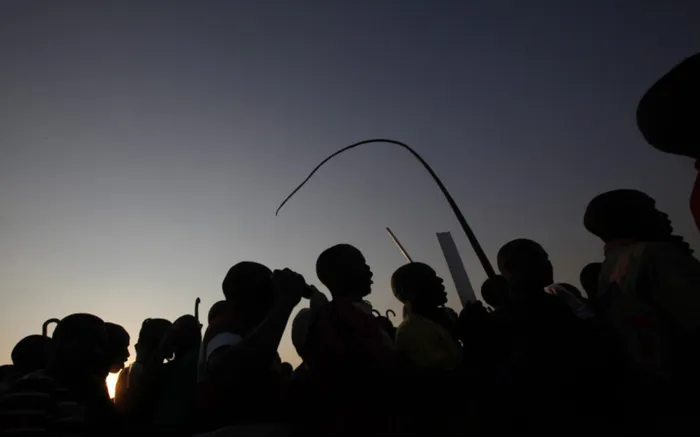
UNDER THE WHIP: Striking platinum mineworkers gather for a report-back on negotiations at Lonmin's Marikana mine this week. The ruling party's reaction to the killing of 34 strikers at the mine earlier this month betrays a defensive posture over state actions and makes a mockery of claims that it cares. Picture: Reuters UNDER THE WHIP: Striking platinum mineworkers gather for a report-back on negotiations at Lonmin's Marikana mine this week. The ruling party's reaction to the killing of 34 strikers at the mine earlier this month betrays a defensive posture over state actions and makes a mockery of claims that it cares. Picture: Reuters
The shock is unabating. Eighteen days later, the scenes of the mine workers collapsing on to the ground, succumbing to lethal bullets fired by the police, still seem surreal.
Has the South African Police Service really handed post-apartheid South Africa its own Sharpeville Massacre?
The question lingers.
None of the visions that filled our dreams of the future, on May 10, 1994, sparked by the sight of Nelson Mandela being sworn into the presidency of the new “Black Republic”, contained an inkling of what would happen on August 16, 2012.
We screamed “ i-buyile i-Afrika”, cognisant that tomorrow would not change much from today.
But, we never, ever thought those entrusted with our safety in a liberated SA would purposely unleash live ammunition on to a free citizenry, especially protesting African mineworkers.
It is not only the 34 corpses that jar, but the awkward symbolism of the tragedy, taking place as it did in a post-colonial state, under an African liberation movement.
This is the conundrum that confronts the ANC: a police force under its charge unleashing violence on to striking, African mineworkers.
An African nationalist movement, the ANC is a custodian of the African working class whom it long identified as the motive force of the liberation movement.
It considered African workers the most reliable, because of the severity of their oppression in the anti-apartheid struggle.
Perhaps even more poignant is that the very idea of an African mineworker is reminiscent of a nationalist grievance.
Mines are symbolic of dispossession and working in a mine is a manifestation of loss of self-reliance.
Mines were the spoils derived from wars of conquest and mine employment a necessity forced upon Africans by loss of land.
Work in the mines, regardless of the atrocious working conditions, was itself a daily reminder of conquest.
Because they did not have any means of livelihood, they had no other choice but to descend deep down into the belly of the earth, without any certainty that it would not swallow them alive.
The nationalist movement was therefore spurred into existence by that daily act of national humiliation. It promised to restore national dignity.
As a constant reminder of that promise to its African masses, the slogan emerged: Mayibuye, i-Afrika! i-Afrika, Mayibuye! The African masses would often passionately chant this, becoming even louder with every chant, as they re-affirmed ownership of their ancestral land.
The Freedom Charter, in 1955, would later articulate the nationalist sentiment in a similarly nationalistic tone: “The national wealth of our country, the heritage of all South Africans, shall be restored to the people.”
The tragedy at Marikana, therefore, sits uncomfortably with both the meaning and promise of a nationalist liberation movement.
It may well be that this incident is meant to peel off the romanticism that envelops nationalism.
Whilst sympathising with the bereaved, the government reacted in typical, official manner: reserve any moral condemnation of the killings, and simply institute an investigation to establish the facts and only thereafter attach blame.
Perhaps the government could not have acted any differently. The police are under its charge, and so condemning them would be self-implicating.
The government is waiting for the findings of the investigation, to determine how it should react to the shooting.
It’s not an emotive response, but very official. It is one based on rules, not emotion. For a cold, bureaucratic government machinery maybe that is forgivable
What is perplexing, though, is the reaction of the party machinery. The initial statement sympathised with the bereaved, but was largely similarly official, ascribing the killings to procedural failures.
The lethal shooting, the statement pointed out, would have been “avoided had the trade union operating at Lonmin and Lonmin mine management found a resolution to the dispute”.
The statement did not express any moral outrage at the killings.
Luthuli House wouldn’t dare condemn the police. Instead, the party followed the cue set by its government counterpart: await the findings, and thereafter institute legal charges.
Surely, the use of violence is unwarranted against striking workers, under any circumstances? Its mere use against strikers, in a democratic society, is deserving of condemnation, especially from a liberation movement that is an embodiment of the aspirations of an African working class.
Could it be that Luthuli House avoided condemning the police killings for fear that it would seem as a rebuke of its fellow party members in government?
Such restraint, however, suggests failure of the party to distinguish itself from state.
This is undesirable for the party on two counts: first, the party is not in total control of the state, and therefore cannot always take ownership of all its failures; and second, it will inhibit the party from exercising oversight, on behalf of society, over its government counterpart.
Bureaucrats don’t always do their jobs.
Even the hardest-working politicians can be failed by a sloppy administration.
The state is simply an instrument by which the governing party can transform society. It is not of its own making, but is an inheritance from the past. In other words, the state is quite capable of stifling the party’s transformative drive.
This demands that the party keeps a vigilant, watchful eye over the bureaucracy, alert to its impulses for a disruptive behaviour.
That hasn’t been happening, however, despite the post-Polokwane undertaking to do so.
Rather than seeing itself as a watchdog, representing the interests of the community, the party still seeks to be part of the state.
Lately, the SA Communist Party, under the guise of the claim that it too is a “party of power”, has also joined the race for “deployment” into official positions.
The problem is most severe at the local government level. That’s what warranted promulgation of the law barring local politicians from simultaneously holding municipal positions. The jury is still out on whether this is yielding the desired outcome.
The lack of party oversight over the government has had disastrous results. A recent and perhaps most glaring case is one of schoolchildren not getting textbooks. Officials have simply and repeatedly, year after year, failed to provide children with the books they need to learn.
They seem determined that our innocent children should grow up to face a bleak future, without hope of a better life. “Where are ANC branches when this happens?” a colleague and an ANC member asked the other day.
The ANC branches are supposed to be the vanguards of their communities.
It may well be that ANC members are aware of the malfeasance, but are themselves beneficiaries.
So, the party’s reaction to the police killing is not out of character.
For a party that is a “disciplined force of the left”, one would have expected an instinctive outrage at the killing of members of its “motive force”.
Instead, it has reacted with legalese that betrays a defensive posture over state actions.
The police should have never emptied their cartridges in to striking workers demanding decent living wage.
This is unforgivable, whatever explanation the judicial investigation comes out with.
It is such silences that make a mockery of the claims that the governing party cares.
If it does, why don’t communities in distress hear its voice and see its display of protest at official abuse?
Residents are left without any defenders, even in the presence of ANC branches, against abuse of power. The civil society formations that have since emerged, therefore, are not opportunistic, but are a genuine response to a local yearning for redress against uncaring public officials.
The national liberation movement was never meant to be a mere party of power, but an embodiment of moral conscience to steer us towards a just society.
Gaining power was never its raison d’être, but simply a means towards achieving a caring society.
Power without moral consciousness could never create a just society. Instead, it becomes self-serving, concerned only with self-perpetuation. Without moral authority, however, a party of power can only shrink and ultimately disappear into memory.
n Ndletyana is head of the political economy faculty at the Mapungubwe Institute for Strategic Reflection (Mistra).