Unconnected in life, united in death
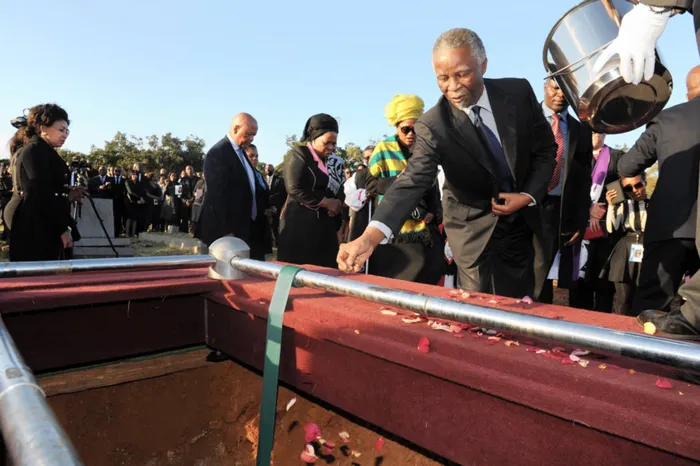
Former president Thabo Mbeki bids farewell to former Chief Justice Pius Langa who was buried at Red Hill Cemetery in Durban last week. Langa's passing, according to Ndletyana, reminds us of the fading of a moral and diligent leadership, which our country so dearly needs. Former president Thabo Mbeki bids farewell to former Chief Justice Pius Langa who was buried at Red Hill Cemetery in Durban last week. Langa's passing, according to Ndletyana, reminds us of the fading of a moral and diligent leadership, which our country so dearly needs.
Pius Langa and Nkosipendule Kolisile were tied together by a tradition of leadership, writes Mcebisi Ndletyana.
Johannesburg - August 3 was probably uneventful to most people. Nothing earth-shattering happened. To others, however, that day was memorable. Burials, for instance, mostly happen over weekends. And, on that Saturday, it was the turn of 74-year-old retired Constitutional Court justice Pius Langa, and Nkosipendule Kolisile, a 40-year-old member of the Gauteng provincial government.
They were buried roughly 450km apart, one in Durban and the other at Port St Johns. They were completely unconnected, belonged to different generations and maybe never even met in life.
But Langa and Kolisile share something in the after-life. They were buried on the same day, yes, but the commonality stretches beyond death. In life they were tied together by a tradition of leadership. Both bucked the trend, epitomising leadership that is increasingly becoming a rarity, if not a subject of ridicule, in our present-day public life.
To understand the distinction and connectedness of the two men, one first needs to appreciate that leadership is contextual. One context exults a certain set of values, while another venerates others. Under conditions of oppression, valour and self-sacrifice in black society turned one into a hero. To be self-centred and materialistic was considered most unbecoming. Human life and freedom, not material satisfaction, was most valued. Some of the wealthy, if not willingly, were shamed into giving.
Human solidarity – caring for the next person – was a defence against the sheer misery of black life, a daily experience in humiliation suggesting that one didn’t matter. Reaching out to others, sharing the little that one had and standing up for justice reassured the despised and downtrodden that they too mattered, black as they were.
They, in turn, adored these individuals for doing nothing else but simply caring and showering them affection.
With the arrival of freedom the old have since made way for a new set of values. Freedom has created space that has nurtured a self-contradictory phenomenon: an affirmation of human dignity, on one hand, and severance of ties of solidarity, on the other. Empathy and collective aspirations have been supplanted by individual pursuit and atomised existence. It appears that being free is not to be in an unrestrained state of self, but has come to mean acquisition of what one was previously denied. It’s catch-up time!
Don’t get me wrong. Trade is one of the many fields that blacks were denied pursuing. And, naturally, freedom implies choice. It is not the freedom of choice that is worrisome. Rather, it is disconnecting from the rest, as one pursues satisfaction of material wants that worries one. It is failure to empathise with the destitute, whilst being self-content at “having it all”, that warrants contemplation.
Because materialism is now a celebrated value, it is less satisfying if not publicly flaunted. Public display of ostentation earns recognition. The African-American scholar, Cornel West, paying tribute to Nelson Mandela on his 87th birthday, reflected on this subject. In his usual eloquent and candid self, West relayed a familiar picture of America’s black middle-class that “has become drunk with the wine of the world, of materialism, narcissism, and hedonism”.
They’ve become like “peacocks, walking around saying, ‘look at me, look at me, look at me!’ Somebody needs to tell those peacocks to stop because they can’t fly”. We too have our own peacocks.
But Langa stuck to old values in a changed context. A black man born into poverty, who started his working life in a factory and rose to the apex of our judiciary, becoming the first black person to achieve that feat, Langa had bragging rights. He never exercised them.
A jurist, Langa’s satisfaction didn’t derive from personal accolades, but from changing our society to live up to its promise of justice and a better life. On being appointed to the judicial bench, after years of toiling and facing racist contempt, Langa didn’t say “I have arrived”, and go around parading like a peacock.
Rather, Langa considered the bench yet another start to making South Africa a humane society. He knuckled down and mingled with the very people he’s meant to serve. This allowed him to share their pain, to cry so that he was reminded of an unfulfilled commitment. Patrice Lumumba, Congo’s anti-colonial hero who was butchered to death at the behest of the Belgians, insisted on continuing to feel pain in order to persevere: “We shall never forget these scars not because we view ourselves as victims solely but rather because these scars, these bruises, these wounds constitute in part who we are”.
Only one who no longer feels the pain, who no longer cries, can embezzle money meant to provide others with nourishment and shelter. They have become disconnected and self-satisfied. They have arrived and with that arrival ended human solidarity.
But Langa showed us that it needn’t be like that. His passing means more than just a physical absence. It reminds us of the fading of a moral and diligent leadership, which our country so dearly needs.
The gap left by Langa’s death was made even wider by Kolisile’s. He was an answer to West’s predicament of what becomes of young people raised under the shadow of a “materialist, narcissist and hedonist” leadership: “And then we wonder why the younger generation does not have access to traditions of the struggle. They don’t see enough of it in the older generation. There is no such thing as ‘young people’s behaviour’ that is not, in part, an imitation of that to which they are exposed. Preach to young folks to be successful rather than to be great and they will think it’s all about success.”
Although thirty-four years younger and less accomplished, Kolisile carried the tradition of an ethical and diligent leadership. He was quite the opposite of his flamboyant peers in the ANC Youth League, refusing to simply follow a crowd or court patronage.
He stuck to principle, even at the risk of expulsion from the South African Communist Party. His open support for protests by Moutse residents in 2005 and 2006 against their town being placed under the jurisdiction of the Limpopo Province went against the wishes of the big chiefs in the party.
And, wanting the party to contest elections independently made him even more unpopular. Kolisile was eventually expelled (and the party has expelled quite a lot of comrades). Had he kept quiet and gone along with the official line, he would have joined the government a lot earlier than he did last year, as an ANC member.
Even though life had become tough, he remained engaged in community activism, resurging to become a regional leader in Gauteng. His appointment to the cabinet was a deserved recognition of his community service. And he remained simple, without the usual colourful, big-collared shirts and shiny pointed shoes.
Langa’s death would be a lot less painful if Kolisile were still alive, pursuing greatness, not success. We remain grateful, however, that they lived.
Their lives are a telling example that one’s convictions needn’t be changed by changing social circumstances.
And the challenge remains for the living: How do we avert a repeat of the Nongqawuse catastrophe, a self-inflicted calamity?
* Mcebisi Ndletyana is Head: Political Economy Faculty at Mapungubwe Institute for Strategic Reflection.
** The views expressed here are not necessarily those of Independent Newspapers.
Sunday Independent