Maimane’s moment of truth for all of us
|Published
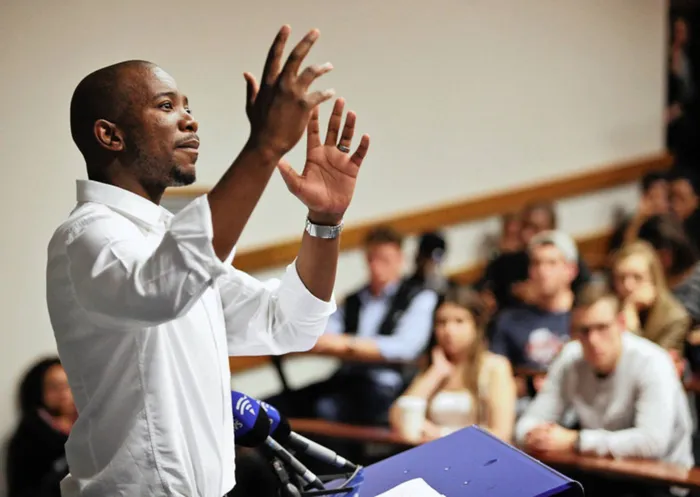
DA leader Mmusi Maimane he tackled racism, saying black South Africans have a right to ask trenchant questions. But he won't defeat racism until whites acknowledge the need for redress, the writer says. File picture: Willem Law/Independent Media DA leader Mmusi Maimane he tackled racism, saying black South Africans have a right to ask trenchant questions. But he won't defeat racism until whites acknowledge the need for redress, the writer says. File picture: Willem Law/Independent Media
White denialism and black myopia cannot hide causes of inequality, writes Mcebisi Ndletyana.
Mmusi Maimane has just had an “Obama moment”. He has had to confront racism publicly, the same way Barack Obama did back on March 28, 2008. Then Obama was fighting a close race with Hillary Clinton for nomination as the Democrats’ presidential candidate.
A junior senator and without a national profile, Obama wasn’t expected to give Clinton a hard time. She was a national figure and praised for her husband’s successful presidency. That Obama proved to be a serious competitor in the primary race came as a shock.
Obama had earned his spot in the race. He’s eloquent, tall, handsome and cerebral. Before becoming senator for Illinois, he had been a community activist. All these qualities add up to electability.
That said, a big part of Obama’s appeal had to do with his biracial parentage: his mother was white and his father an African, from Kenya. He spent a significant part of his childhood with his white grandmother in Hawaii. While he defined himself black, he was not a typical “brother”.
Obama was a transcendental candidate. He had been shaped by the white and black worlds. He was not insensitive to the burden of blackness, nor did he carry black rage against white folk. In Obama, progressives saw the ideal that America sought to achieve, a conduit to “a more perfect union”.
Then the Reverend Jeremiah Wright happened. Wright was Obama’s pastor, officiated at his wedding and baptised his kids. He was Obama’s spiritual mentor.
All that was fine, but Wright, like all authentic black priests who believe in social justice, was prone to speaking harshly against American officialdom. At times his choice of words was excessively harsh, which mainstream America caricatured as extremist.
In a typical attempt to smear a rival, Obama’s detractors found videos of Wright delivering sermons and showing him at his harshest self against the establishment. In one video, Wright says US foreign policy was partly to blame for the attacks in September 11, 2001. Terrorists had done what officialdom exported to other countries: “Chickens have come home to roost.”
In another video, Wright not only indicts officialdom for America’s ills, but condemns the US: “When it came to treating her citizens of African descent fairly, America failed. She put them in chains, the government put them on slave quarters, put them on auction blocks… The government gives them drugs, builds bigger prisons, passes a three-strike law and then wants us to sing God Bless America.
“No, no, no, not God Bless America. God Damn America.”
Wright stunned mainstream Americans. Even more shocking was that he preached at Obama’s regular church. The sermons were unlike what people imagined Obama’s thinking to be.
If Obama was what they believed him to be, how could he have an “extremist” priest as his pastor, mainstream Americans asked themselves. This is what Obama’s detractors had hoped to achieve – to sow doubt about Obama’s character, after which they’d dismiss him as “no different from the rest of them”.
Then Obama did the unexpected. He faced the controversy head-on. In one of the best demonstrations of oratory, Obama didn’t disown Wright. Rather, he explained him as a perfectly understandable product of an American society. He didn’t agree with him on everything, but Wright was not an anomaly.
“For the men and women of Reverend Wright’s generation, the memories of humiliation and doubt and fear have not gone away; nor have the anger and bitterness of those years. That anger may not get expressed in public, in front of white co-workers or white friends. But it does find voice in the barbershop or around the kitchen table.”
Obama reminded his audience that racism was alive in America. Wright was not delusional. Even his grandmother at home, Obama said, was not free of prejudice.
“I can no more disown him than I can my white grandmother – a woman who helped raise me, who sacrificed again and again for me, a woman who loves me as much as she loves anything in this world, but a woman who once confessed her fear of black men who passed her on the street, and who on more than one occasion uttered racial or ethnic stereotypes that made me cringe.”
That speech, titled, “A more perfect union”, was a risk for Obama. He was forcing white America to admit culpability for the ills that plagued black America.
Their relative prosperity was not solely the result of hard work, but had been gained through preferential treatment.
Obama was not apologising for his association with Wright. Instead, he called on white people to face up to reality. They seem to have done exactly that. Obama is completing his second term, based largely on the support of white voters.
Racism remains a problem in America, but whites electing a black man who prodded them to confront their racism was a historic milestone towards overcoming racial prejudice.
Maimane took a similar risk on Tuesday. Previous leaders of the DA have largely shied away from discussing race. Helen Zille transformed the face of the party, but was ambivalent on racism and redress.
Tony Leon denied racism out of existence.
Maimane has remained true to his inaugural promise, and recent racial utterances have made his speech even more urgent.
His speech was bold and pointed.
“As black South Africans,” he said, “we are entitled to ask uncomfortable questions. We are entitled to ask why a black child is 100 times more likely than a white child to grow up in poverty.
“We are entitled to ask why a white learner is six times more likely to get into university than a black learner. We are entitled to ask why the unemployment level of young black South Africans is well over 60 percent.”
Anyone who denied this racialised inequality, Maimane suggested, was a racist and not welcome in the DA.
Maimane faces a huge problem. No one is racist in today’s South Africa. White South Africa is in denial. They refuse to acknowledge or discuss the savagery of racism. Acknowledging means admitting complicity. Only when white society faces up to the past, and acknowledges the legitimacy of racial redress, will Maimane silence racist outbursts in his party.
It now appears, however, that white denialism is not the only problem for Maimane. He also has to grapple with black myopia and claims of exceptionalism.
The DA’s mayoral candidate for Joburg, Herman Mashaba, has just made the inexplicable remark that race does not matter. Mashaba arrived at this conclusion purely because he overcame racial barriers to become a successful businessman. He has substituted the entire black history and experience with his own. Mashaba defines himself as the totality of blackness.
One supposes Mashaba to be a “special black” who risks becoming a poster boy for racists. They’ll brand him an example who shows that most blacks are just lazy, and that racism has nothing to do with their social deprivation. Mashaba has not only complicated Maimane’s task, but lessened the DA’s electoral prospects. What a terrible start to a campaign!
* Ndletyana is an associate professor of political science at the University of Johannesburg, and a Fellow at Mistra.
** The views expressed here do not necessarily reflect those of Independent Media.
Sunday Independent