

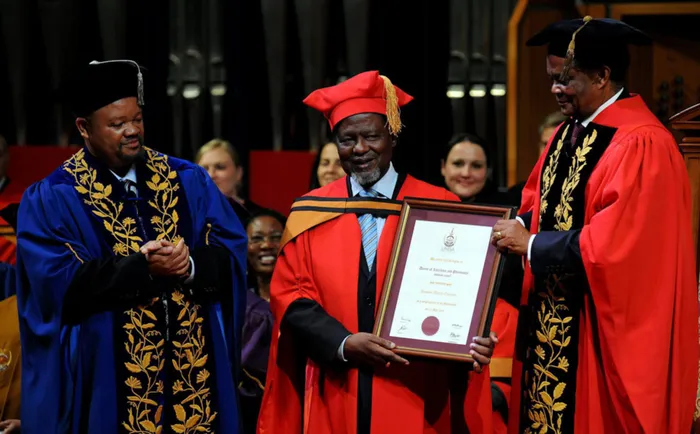
'YOU CAN DO MORE': Former Mozambican president Joaquim Chissano, centre, receives a doctorate from Unisa chancellor Judge President Bernard Ngoepe, right, and vice-chancellor Prof Mandla Makhanya, left. Academic institutions have a duty to recognise those who fought for democracy, says the writer. Picture: Phill Magakoe 'YOU CAN DO MORE': Former Mozambican president Joaquim Chissano, centre, receives a doctorate from Unisa chancellor Judge President Bernard Ngoepe, right, and vice-chancellor Prof Mandla Makhanya, left. Academic institutions have a duty to recognise those who fought for democracy, says the writer. Picture: Phill Magakoe
In his heyday, former president Thabo Mbeki, whose depleted political stock saw him ejected from office in the most unceremonious manner, did really well in the transformation of our country.
His bold challenge to the black intelligentsia to come out of their shell and participate in the national discourse came to mind this week as I sat at a Unisa graduation ceremony.
So many of our people have served the country selflessly in various spheres – under impossible circumstances – and yet the bulk of them have not been recognised by our academic institutions.
This is despite the fact that following the dawn of democracy in 1994, these academic institutions have been placed under black leadership as part of transformation and reflection of the desired direction the country ought to be taking.
I was recently privileged to be a special guest of my role-model, mentor, brother and friend – Mothobi Mutloatse.
He was bestowed a Doctorate in Literature and Philosophy in recognition of his outstanding contribution to knowledge production in black South Africa during the dark days of apartheid. Professor Mandla Makhanya, the vice-chancellor and principal of Unisa, was visibly elated about his decision to honour Mutloatse. He waxed lyrical about the man’s contribution to society, and left me thinking that more exciting developments might be under way at Unisa.
Not so long ago, it would have been inconceivable for Unisa to heap praises and honour someone whose mission had been to dispel the myth of race supremacy.
This is in my view what the new South Africa expects from our universities – reflect accurately on the development and evolution of society as well as the historical effect and influence of individuals and groups to the greater good of our nascent democratic order.
For the uninitiated, black thought which challenged the illegitimacy of the minority regime was not only discouraged through coercive means, it was menacingly prohibited and transgressors either banned or jailed.
Mutloatse, 61, founded the literary magazine, Staffrider, and Skotaville publishers in 1982, which he named after one of his heroes – former ANC secretary-general Mweli Trevor Skota (1893-1976).
He caught the eyes of friends and foes alike in 1982 when Skotaville published Archbishop Emeritus Desmond Tutu’s first book, Hope and Suffering, which Mutloatse personally edited and for which he also wrote the foreword.
The book became an instant best-seller and was translated into Dutch, Spanish, Norwegian, Swedish, German and Japanese. According to Mutloatse’s circulated profile, “the German version alone sold over 80 000 copies, an accomplishment which was unheard of for a non-German and African cleric”.
Soon thereafter Mutloatse unleashed a series of publications by authors who would become household names in the country’s national psyche.
These included Neville Alexander, Allan Boesak, Frank Chikane, James Cone, Philip Kgosana, Bob Leshoai, Chabane Manganyi, Don Mattera, Fatima Meer, Itumeleng Mosala, Buti Tlhagale, Sipho Sepamla Tim Couzens, Motsoko Pheko, Jonathan Jansen, Bishop Mvume Dandala and many others.
In 1996 Mutloatse repositioned Skotaville publishers and changed it into Mutloatse Arts Heritage Trust. Under the new vehicle he has published, among others, Sandi Baai’s O R Tambo: Teacher, Lawyer, Freedom Fighter and Peter Magubane’s photographic tribute to Nelson Mandela titled Man of the People, which he co-published with Macmillan in 2008.
Now, how could someone with such an impeccable record not catch the eyes of so many heads of universities who, by mere assumption, should be aware of our past as well as our present?
What good is there when black academics seem all but assimilated into the traditional status quo where black thought played second fiddle to the Western ways of looking at things?
I am not calling on our academic institutions to dish out honorary degrees like candy, but the story of giving South Africa what Steve Biko referred to as the “greatest gift of all – a more humane face” – was only achieved through the sacrifices of men and women who could have chosen to do nothing.
The role of our universities should be to provide leadership primarily in the field of knowledge production – through constant research – breaking new ground. Our demographics also dictate that despite our past ghastly inequities, the voices of the majority of the citizens have to be heard.
Black heads of our academic institutions have to display some semblance of understanding of our country’s transformation agenda and contribute meaningfully in that regard.
It serves no purpose to open the floodgates of opportunity for the previously marginalised academics who occupy the highest echelons of our institutions and do very little or nothing to affirm deserving citizens for fear of courting controversy.
There are many like Mutloatse throughout the length and breadth of our country who should be singled out for honours.
These are the sons and daughters of our land without whose gallant contribution to the birth of a new stable society we might have wallowed in the quicksands of a revolution.
Honour them, I plead.
l Makoe is the founder and editor-in-chief of the Royal News Services.