

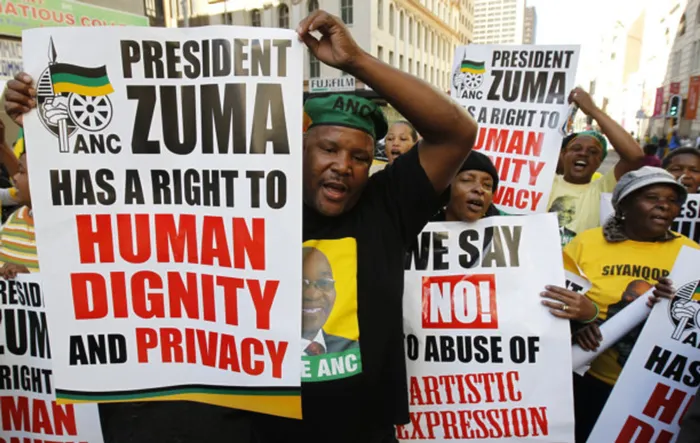
PAINFUL HISTORY: President Jacob Zuma's supporters were understandably aggrieved in voicing their anger against Brett Murray's painting The Spear, given the country's deeply embedded history of racism. Picture: Reuters PAINFUL HISTORY: President Jacob Zuma's supporters were understandably aggrieved in voicing their anger against Brett Murray's painting The Spear, given the country's deeply embedded history of racism. Picture: Reuters
IT is a road frequently travelled, a script too familiar but never mundane. Yet it is, in many respects, a wonderful story of our democratic mutations. We want freedom of expression badly. Many died for simply telling it like it is, as we would say at this paper. We also want others to respect our dignity, not be too invasive (if at all) and never to defame us. Yet, somewhere in between, lies our promised land. But getting there we must go through formidable, yet insuperable challenges.
The story of President Jacob Zuma’s senior counsel, Gcina Malindi, breaking down in court yesterday under a deluge of questions and emotions, as he recalled his story, our story, encapsulates this difficult path we must trudge to the promised land of the free.
Around the globe, the balancing act remains a tricky affair. Many celebrated when Julian Assange, the infamous Wikileaks boss, released many diplomatic cables, laying bare the disconnect between what some politicians said in public and private. News of the World used underhand means to eavesdrop on UK citizens, mostly celebrities, and published embarrassing information considered an affront on the dignity of their subjects. Or who would forget SkyNews “forgetting” a live microphone on Gordon Brown, who, believing he was free to express private thoughts after an encounter with pensioner Gillian Duffy, found himself in the eye of a storm after describing her as “bigoted”.
The need always to balance freedom of expression and the right to privacy, often couched as a right not to have one’s dignity invaded – a clash of liberties – is as old, and perhaps as emotive and divisive here at home, as democracy itself.
The right to freely express oneself is the putative centrepiece of democracy, for, without it, our system of governance will be imperiled. Human development rests heavily on our ability to freely express our feelings and thoughts, and to receive the same. Yet, similarly, unrestrained expressions and unlimited intrusive conduct by others, including the media and artists, could imperil the very development democracy promises.
Zuma’s supporters say that his right to dignity has been violated by a racist who insulted all black people by showing Zuma’s penis. Those who defend the artist Brett Murray say that he has done anti-apartheid artworks and is, therefore, beyond racism. First, Zuma’s supporters accuse Murray of racism without a shred of evidence. But the fact that they do not adduce evidence does not mean that this may not be so. Further, the fact that Murray has earned his revolutionary stripes by taking swipes at the apartheid regime does not mean he can’t be racist. To say that he can be racist is not to say that he, in fact, is.
The ANC often reminds us that it has fought for freedom and democracy, and that it is absurd to accuse it of endangering our democracy. Its spin doctors never want to hear arguments that the champions of freedom can, in no time, become villains, much less despots. Look at Robert Mugabe. Or, closer to home, Tony Yengeni, Mac Maharaj et al. The point is that it is nonsensical to say that because Murray has fought racism in the past, he can’t now be racist.
Writing about writing, Nadine Gordimer says: “But life is aleatory in itself; being is constantly pulled and shaped this way and that by circumstances and different levels of consciousness. There is no pure state of being, and it follows that there is no pure text… Any writer of any worth at all hopes to play only a pocket-torch of light – and rarely, through genius, a sudden flambeau – into the bloody yet beautiful labyrinth of human experience, of being.”
If indeed there is no pure text, it follows that there can’t be a pure drawing. Murray is influenced and his being is, as Gordimer puts it, “shaped this way and that by circumstances and different levels of consciousness”. So his protest artwork comes from a lace in his mind that also requires interpretation, understanding and critique. Given our history, it, I guess, came as no surprise to Murray that he has been labelled a racist, even if this was unfair.
SA has a terrible, deeply embedded and hard to eliminate history of racism. This presents us with a number of problems. We impute very negative intentions on people’s conduct without much probing. When you are white and your subject is black, and your comments or conduct not complimentary, it is easy, lazy perhaps, for people to tar you with the racist tag. They might throw “bigoted, pig” in there for measure. While our history makes it easy to understand why this is done, it remains nonetheless wrong.
My sense, too, is that the poorly done artwork that is The Spear is neither illegal nor desirable. It’s as provocative as it is poorly done. The import was cheap fame. Yet, it could be publicly justified. As Karl Popper says, man wrestles with fame and fate because “we are educated to act with an eye to the gallery”. And Murray did not come up with his “art” without an eye to the gallery. Murray was known and appreciated by those who, in the main, love and follow art. Today, his name is common even among taxi drivers. Louis Mabokela, the taxi driver from Limpopo who defaced The Spear, is a living example.
Murray, though, can easily justify his artwork. We just need to ask ourselves why Murray chose Zuma – not Blade Nzimande, not Mugabe, not Tokyo Sexwale or Kgalema Motlanthe. Zuma says he is neither a womaniser nor a philanderer. He most probably knows himself better than all of us. That we know Sonono Khoza was impregnated out of marriage, or that the encounter with Khwezi, which led to Zuma’s rape trial for which he was acquitted, happened outside of marriage is not of much consequence, right?
Murray knew that Zuma’s public sexual history would make the message stick. The fact of his whiteness escaped him. He probably did not foresee that many will look at him and say, even if Zuma’s sexploits are embarrassing, who are you to suggest our leader has a loose zip? Our context, our history, escaped Murray. The purists will say the constitution allows him to draw whoever he wishes to. True. As Chris Rock would put it, the fact that it is not illegal to drive your car without your shoes on doesn’t make it a good idea! In other words, when people are angry at him, when people deface his work, when people threaten him with violence, when people generally overreact, he and the gallery should not be surprised. The reaction is over the top because the drawing is in bad taste – even though it is allowed by the constitution.
Under common law statutes, Salman Rushdie is free to publish the Satanic Verses about Prophet Mohammed. Yet, today he is on the run because writing the book was legal, but not a very good idea.
For Zuma, his lawyers will need to prove iniuria, which is considered the wrongful and intentional impairment of physical integrity (corpus), dignity or reputation. The Constitutional Court has already found that “the concept of dignity has a wide meaning, which covers a number of different values. So, for example, it protects both the individual’s right to reputation and his or her right to a sense of self-worth”.
Murray played within the legal limits, tested our levels of tolerance and caused a top lawyer to shed tears publicly. That is democracy at work.