

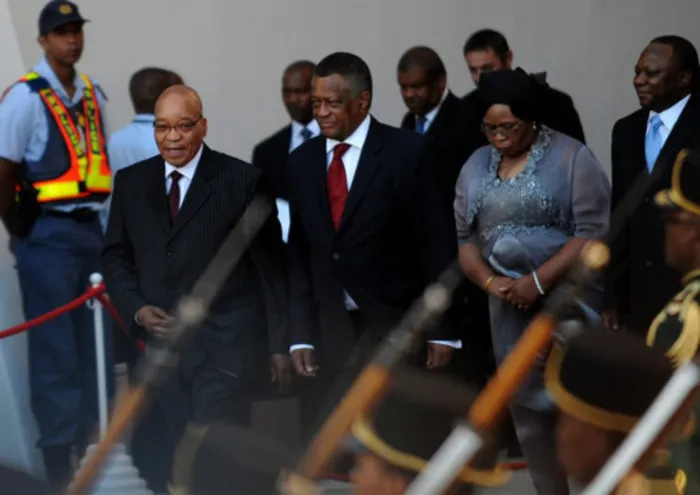
ALL TALK, LITTLE ACTION: President Jacob Zuma, flanked by Speaker of Parliament Max Sisulu, before his State of the Nation address in 2009 " when he promised to make SA a "great country". Picture: Cindy Waxa ALL TALK, LITTLE ACTION: President Jacob Zuma, flanked by Speaker of Parliament Max Sisulu, before his State of the Nation address in 2009 " when he promised to make SA a "great country". Picture: Cindy Waxa
IT was on June 9, 2009 when President Jacob Zuma stood up in Parliament to respond to statements and questions put to him following his maiden State of the Nation address.
Parliamentarians had quizzed him about the kind of parliament he wished for his presidency, among other things, following criticism that Parliament was weak and full of yes-men and -women. It was, in Dickensian terms, the best of times. The country’s prosecutors had just dropped fraud and corruption charges. Zuma’s cabinet had just been unveiled and he appeared to have had his thumb on the heartbeat of the nation. When the niggling question about whether he wanted his own yes-men and -women came, he responded: “Regardless of our differences as political parties, I believe that we have a common goal, which is to make South Africa a great country. We take all contributions to the debate in that spirit. We have noted, too, Honourable Speaker, that this House will seriously hold the executive accountable. As Honourable Thaba Mufamadi said, this will be a ‘strong activist Parliament’.”
This was part of the many positive things accepted with high alacrity that marked Zuma’s first days in power. He promised us Mandelaesque reconciliation, too. Excitement, without caution, was in the air.
That was then.
Fatigued by Brett Murray’s Spear, I was, like many, relieved this week to see that none but the authority of Max Sisulu, the political head of our Parliament, has introduced something much more interesting, more profound, for what it portends for our future. He said the “quality” of legislation coming out of Parliament was a matter that concerned him.
“I am concerned that more and more legislation is returned to the National Assembly for correction, either section 75 legislation which the NCOP (National Council of Provinces) has recommended that the Assembly amends to make it constitutional, or legislation that was found to be unconstitutional by the courts,” Sisulu said. “As the subject matter of legislation becomes more sophisticated and highly technical, our Parliament and members must become more professional. This requires the necessary capacity, both in terms of technical support by the officials and capacity-building for members.”
Unlike the Murray saga, Sisulu’s words were important not for what they meant, but also the person behind the words. Were these words to come from the DA, some would dismiss them as maladroit, hubristic adventure by people trying to score cheap political points.
Unlike in the Murray saga, where his whiteness was transmogrified into a premise of an affront, Sisulu has no such inhibitions. He is black, he has Struggle credentials and was born into Struggle royalty. Unlike, say, Julius Malema, his future does not hang in the balance. In fact, he is the political head of the national legislature. So when he says that he is concerned about the poor quality from largely ANC legislators, his comrades, we must, as citizens, be equally concerned.
The essence of his criticism is that the people the ANC put forward as representatives of the people are, in fact, letting down the very people they are supposed to represent. The MPs have allowed mediocrity to set in. The people’s representatives either have scant regard for the constitution, or lack the political nous to navigate the terrain of lawmaking without acceding to party political demands that might contradict the supreme law in the country.
Sisulu puts this down to legislators and their advisers ignoring research from well-established research bodies and poor attendance of committee sittings. This is important for many reasons, chief among which is the fact that our democracy, our very constitutional order, rests on our ability to fill institutions like Parliament with people who will always act in the interest of the people – rather than have their actions threatening the interests of the people.
Currently, the Sexual Offences Amendment Act is one of the oft-quoted miscarriages by our bright sparks at Parliament. Some good MPs are in the process of correcting this defective piece of legislation which saw a judge in the Western Cape rule that because some parliamentarians failed to do the basics, a rapist should be allowed to walk free. This is not mere sloppiness occasioned by ignorance. It is a continuum of wayward disregard of the interests (pain) of people.
We see this disregard in the Protection of Information Bill, where, through gritted teeth, parliamentarians initially argued against the public interest clause, thinking, wrongly, this was a slap in the face of grumpy, old, white media owners when, in fact, this went to the heart of freedom of expression – a right enjoyed by many ordinary members of society. A right many fought to protect from sloppy, wayward MPs.
We see this sloppiness in the Traditional Courts Bill, where ANC MPs try to play politics and thus trample, illegally, on basic rights of women in rural areas. The bill, some say, is aimed at appeasing chiefs and traditional leaders ahead of the 2014 general elections. This comes as the ANC contends with waning support in urban centres. The ANC experienced electoral decline in all provinces but KwaZulu-Natal in the last general election.
Nations fail because important institutions like Parliament are not challenged enough or are populated by lazy MPs. Apartheid architects, with rueful smiles, must be thinking: we told you! Many South Africans simply cast their votes and hope that those who carry the historical responsibility to lead, do, in fact, know something about leadership. So ingrained is the sloppiness and deliberate disregard of our laws, especially the constitution, that this has spawned several organisations.
The power, real power, to change this rests firmly in the hands of active citizens. The e-tolls was temporarily halted because a group of active citizens, organised under People Opposed to Urban Tolling, stood up against the wrong they saw perpetrated by an elected government. The SA National Editors Forum and others who were opposed to the Secrecy Bill stood up and took action. I am excited about Mamphele Ramphele’s Citizens Movement for Social Sector Change because it is crucial to undoing the damage that years of miseducation have done.
Sipho Pityana’s Council for the Advancement of the SA Constitution and Freedom Under Law upends the idea that those with the might of the state behind them can simply bully us, force their versions of the truth upon us, and that citizens must simply roll and cry victim. They stood up and are acting. They know that it takes a few good men to keep silent when mediocrity sets in for things to fall apart.
All of these organisations, I am certain, share Zuma’s State of the Nation response and the common goal of which he spoke – to make SA a great country. As Prince Mashele criticises Zuma; as Mamphele takes the government to court, ditto Hugh Glennister; as Sisulu criticises his sloppy comrades; the point always, I believe, is to do what Zuma promised us in 2009: the creation of a great country.