

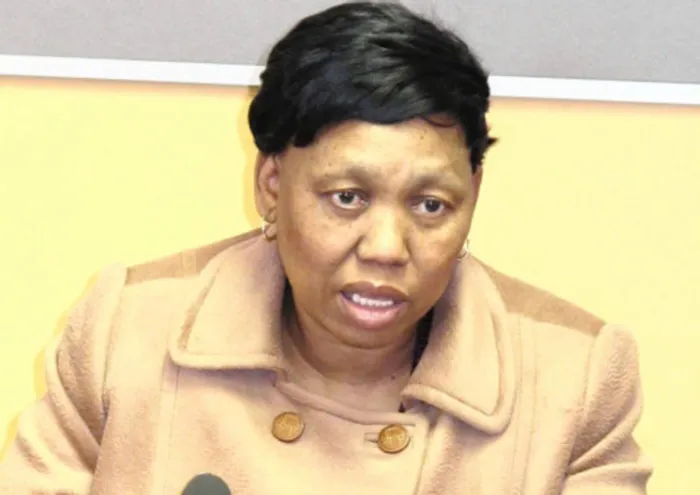
ACCOUNTABLE: Basic Education Minister Angie Motshekga at a briefing in Polokwane recently about the textbook crisis in Limpopo. The minister hasn't apologised for the scandal, says the writer. Picture: Moloko Moloto ACCOUNTABLE: Basic Education Minister Angie Motshekga at a briefing in Polokwane recently about the textbook crisis in Limpopo. The minister hasn't apologised for the scandal, says the writer. Picture: Moloko Moloto
AN MEC walked up to a pupil at a school in Limpopo and asked: Who is the premier of the province?
The pupil, energetically, blurted: “Jacob Zuma?” This was an anecdote shared by Pitsi Moloto, Limpopo’s MEC for Roads and Transport, at a media lekgotla held in Limpopo recently. Moloto was demonstrating the need for a media that informed and educated, to help eradicate ignorance that held society back.
Last week, as part of celebrating my birthday, my significant other booked us one of those spend-the-whole-day-relaxing sort of gig on a smallholding outside of Pretoria. The woman assigned to me was a lively, talkative sort. As she did her job, she started talking about politics.
Without a hint about what I did for a living, or whether I was related to President Jacob Zuma, she professed to me her unmitigated dislike of our leader. The journalist in me took her down on that trip – asking questions without revealing my background. She went on to complain about Zuma’s lifestyle and personal choices about his wives and the number of kids he had before adding: “His government has failed to change the lives of the poor, like us. We work, but we depend a lot on tips.”
After a long lecture on Zuma, I asked her how she is solving her well-identified problem. “I won’t vote again,” she said. Her well-considered response to her problem was inaction. People died for you to have the right to vote, I pushed.
“These politicians are the same,” she protested. “None of them will have my vote,” she promised. For her, inaction was sufficient punishment.
Her stance is, of course, an expression of her ignorance, in the same way that a pupil is ignorant of her premier. Much of the ignorance that afflicts many in our country is rooted in the poverty. This poverty makes it hard to afford a school uniform or the like. A newspaper is a luxury. The cycle never ends. A life of poverty makes you ignorant and your ignorance makes you more poorer.
“Persistent poverty,” writes Francis Fukuyama in The Origins of Political Order, “often breeds other kinds of social dysfunctions, like gangs, narco-trafficking and a general feeling of insecurity on the part of ordinary people.”
In the Western Cape, Premier Helen Zille, tired and almost helpless against the sheer power of gangs, has put out an SOS to Zuma to send in the defence force to stop gang activity. She hopes that were this to stop, it would put to an end to other social dysfunctions, including ignorance, of which Fukuyama speaks. But the gangs are merely a symptom of the poverty that forces many to join the bandits.
Fukuyama also counsels that “most people around the world would strongly prefer to live in a society in which their government was accountable and effective”. Unfortunately, though, not many around the globe have that luxury. For us, ignorance is a huge impediment to accountability.
When a politician is found with his fingers in the cookie jar, as The Star did with Humphrey Mmemezi, action taken against them is superficial, if at all. There is consideration as to which faction he belongs, how his removal would impact on the support he brought and the general intra-party chess games. This is why, instead of removing Mmemezi from the legislature, the ANC in Gauteng was only too pleased to deny him the blue lights and other privileges by forcing him to step down as MEC, but retaining him as a provincial legislator.
The very reasons that make it impossible for him to be an MEC are not, according to the party, sufficient to have him removed from the legislature.
We are ignorant and uninvolved in things we ought to take ownership of. We believe that someone else will take up arms on our behalf and insist on accountability. We looked on and did nothing until Section 21 came along to demand accountability by those denying pupils books in Limpopo. Even when Angie Motshekga, Basic Education Minister, is forced to admit that she messed up in Limpopo, she can’t find it in herself to apologise. She is too important a person to do that. She knows we expect less and even when that is not met, we are too accomodating of mediocrity for her to be bothered. It is the same thinking that afflicted Mmemezi, as he thought himself too big a person to buy baked beans using his own bank cards. Why would he do that when he had a government-issued credit card, right?
This lack of accountability, being too important to be tied down by small government rules, is cancerous. It spreads quickly. Look at the report by Auditor-General Terence Nombembe on the performance of municipalities.
When those who manage our finances in municipalities see the Mmemezis of this world do what they do and get away with it, they ask themselves why they can’t be allowed to misappropriate a mere R11 billion and be allowed to get away with it. What’s good for the geese…
Nombembe told us three weeks ago that many people in key posts in municipalities were ill-equipped for such posts. But do we see people up in arms, demanding that someone in authority do something about it?
What has happened to the money misappropriated in past financial years? Do we care enough to want to know – or are we comfortable in our ignorance?
Nombembe tells us: “Bad (audit) results are regarded as a norm and when people get a disclaimer or qualified reports, little happens to them to show that this is unacceptable.”
When politicians are not accountable, they know the harshest punishment is likely to be, at the worst of times, a withheld vote – rather than a vote against them. What we desperately need as a start is a knowledgeable, informed citizenry. Not all citizens will be activists, however helpful it might be. But an informed citizen will take informed decisions.
The need to be informed is not just about schoolchildren who do not know who their premiers are. It is not merely about an angry young woman who feels betrayed by the choices Zuma makes.
“The shift to democracy,” insists Fukuyama, “was a result of millions of formally passive individuals around the world organising themselves.” Information and knowledge about themselves and the world around them helped a great deal, he says.
The Star runs an education page every Monday because it is through education – and newspaper reading, of course – that we can rid our country of ignorance.
l This is an edited version of a lecture delivered at a seminar for the Union of Jewish Women in Joburg on Monday.