

Not all bottled water is created equal: the hidden dangers in South Africa’s drinking water.
Image: Pixabay
A bottle of water should be the simplest thing in the world. Clear. Clean. Safe. But after spending two days inside Thirsti’s bottling plant in Tulbagh with the South African National Bottled Water Association (SANBWA), one uncomfortable truth became impossible to ignore: not all water sold to South Africans is created equal.
South Africans are living through a strange contradiction. We are buying more bottled and filtered water than ever before because trust in municipal water systems is slipping.
In a country already battling crumbling infrastructure, water shortages and growing fears around contamination, what we put into our bodies matters more than most people realise.
What looks like a harmless refill station at your local shop or a cheap container of water could actually be part of a much bigger, unregulated problem.
According to SANBWA CEO Charlotte Metcalf, South Africa is quietly facing a rise in unregulated water refill businesses, many of which operate entirely outside food safety laws.
Some refill stations not only fill customers’ bottles but also pre-fill and seal water bottles for sale, which legally classifies them as packaged water products.
The concern with this is that many have no traceability systems, no verified source testing, inconsistent sanitation practices and no way to track contamination if something goes wrong. People think they are buying safe drinking water, but there is often no real way of knowing what is actually inside that bottle.
As the nation faces a growing crisis of trust in municipal water systems, South Africans are increasingly turning to bottled and filtered water as a solution.
Image: Pixabay
Ecoli (Escherichia coli) is a bacterium.
While some strains are harmless, their presence in drinking water is a universal red flag for faecal contamination.It means human or animal sewage has leaked into the water supply.
Recent investigations by WaterCAN found E. coli contamination in nearly a third of tested school water sources across five provinces.
Similar contamination concerns have also surfaced in municipalities where household taps and water tanks tested positive.
When you drink water contaminated with dangerous strains of E. coli, it releases toxins in your gut. This leads to severe abdominal cramps, bloody diarrhoea and violent vomiting.
For healthy adults, it is a miserable week of illness. But for infants, the elderly, and anyone with a compromised immune system, it can cause haemolytic uraemic syndrome (HUS), a terrifying condition that causes kidney failure and can be fatal. This isn't just "dirty" water; it is a serious public health hazard.
Walking through the Thirsti plant in Tulbagh, surrounded by the dramatic Klein Winterhoek mountains, the process felt less like a factory tour and more like watching a science lab operation in real time. Every stage, from groundwater extraction to bottling, sealing, recycling and microbiological testing, is closely monitored.
“We don’t let any of our members draw directly from a spring anymore because spring water is contaminated as hell,” said hydrogeologist John Weaver during a technical tasting and groundwater session.
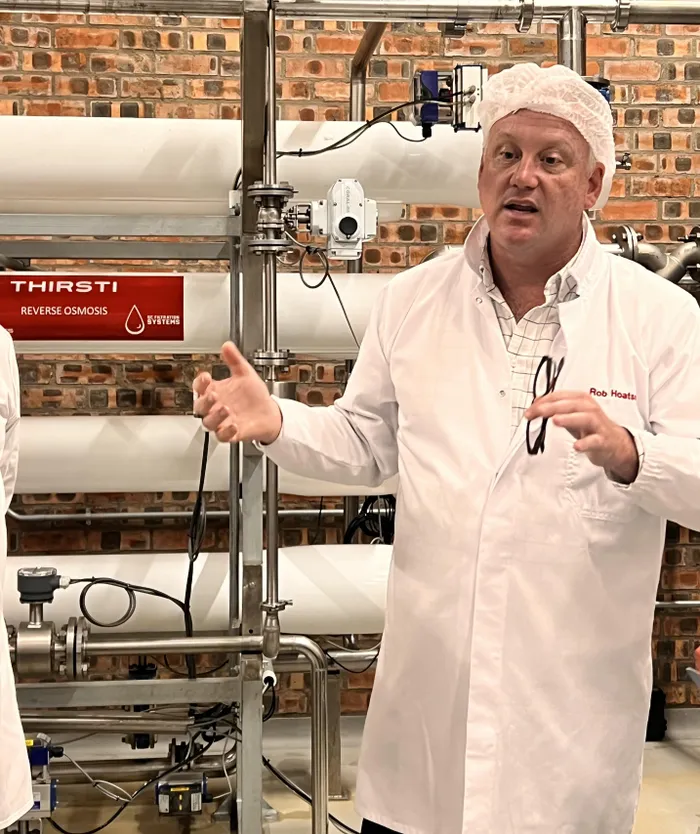
Thirsti Water founder Rob Hoatson shows journalists how the bottling process works during a media tour of the company’s new water plant in Tulbagh.
Image: Vuyile Madwantsi
That statement alone challenges one of the biggest wellness myths many consumers believe: that “natural spring water” automatically means cleaner or healthier water. Weaver explained that untreated surface spring water is exposed to the elements. It often contains bacteria, insects, decaying plant roots, and animal droppings. Instead, SANBWA members drill sealed boreholes deep into underground aquifers to protect water from human contamination and harmful bacteria like E. coli and Pseudomonas.
It sounds technical, but the takeaway is surprisingly simple: safe water depends less on marketing words and more on rigorous testing, sanitation, and traceability.
Because of water shedding and municipal failures, South Africans have adapted by changing their water habits. However, our alternative sources come with major blind spots.
The rainwater catchment trap:
Many households have installed JoJo tanks to harvest rainwater, assuming it is pure because it comes from the sky. This is a dangerous misconception. As rain falls, it washes pollution and chemical emissions out of the air. Worse, it hits your roof.
Your roof is covered in bird droppings, lizard faeces, decaying leaves, insects and dust. When rain washes this mixture into an unsterilised tank, it becomes a warm, dark breeding ground for E. coli and Salmonella. Without a proper filtration system and UV or chemical sterilisation, drinking rainwater or using it to wash food can make your family incredibly sick.
While bacteria pose immediate health concerns, many fail to recognise the long-term dangers posed by chemical contaminants. Unregulated stations that use insufficient filtration might not remove heavy metals or agricultural nitrates, both of which result in severe health consequences.
Microplastics and packaging toxins: If a refill station pours water into low-grade plastic bottles, or if those bottles sit in the South African sun, chemicals like antimony and BPA leach directly into the water. You aren't just drinking water; you are drinking the container it is in.
This is where many South Africans understandably get confused. Not all water comes from the same source.
Natural groundwater or borehole: Drawn from deep underground aquifers, naturally filtered by layers of rock and rich in minerals.
Prepared or municipal water: Tap water pushed through advanced purification systems (like reverse osmosis) to strip everything out, then remineralised for taste.
Refill water: Often just municipal tap water run through a basic, under-maintained countertop filter in a retail shop and poured into a bottle you brought from home.
If those reused bottles are not chemically sanitised before refilling, the bacteria from your hands and mouth multiply inside the bottle, contaminating even perfectly filtered water.
"Know what you buy," warned Thirsti founder Rob Hoatson during the media briefing.
Here are the biggest consumer takeaways experts repeatedly emphasised during the visit: