

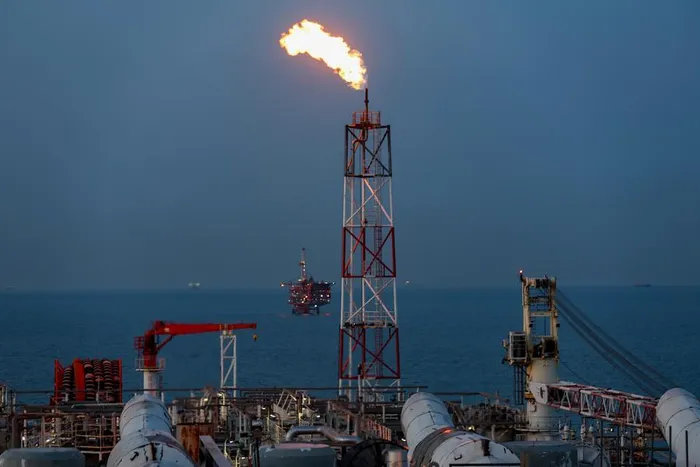
A drone photo taken on March 8, 2024 shows the "Bohai Century" Floating, Production, Storage and Offloading (FPSO) unit at dawn in the Qinhuangdao 32-6 Oilfield, north China's Hebei Province.
Image: XINHUA
At the start of 2026, the oil and gas industry was bracing for something nobody would have wished for but most analysts saw coming, a significant oversupply problem. Production from the US, Brazil, Canada, and Kazakhstan was growing faster than demand. OPEC+ was struggling to hold the line. Forecasters at the IEA and EIA were projecting a surplus of up to 4 million barrels per day in the first half of the year, and oil prices were expected to drift into the low-to-mid $50s per barrel. The story heading into this year was going to be about discipline, cost-cutting, and whether OPEC+ could hold its members together. Then February 28 happened.
When the United States and Israel launched military operations against Iran, the IRGC moved almost immediately to block shipping traffic through the Strait of Hormuz (the narrow passage through which roughly 25% of the world's seaborne oil and 20% of global LNG had been flowing). The market that was heading toward a glut was turned upside down in a matter of days.
Brent Crude surged past $120 per barrel within weeks. QatarEnergy declared force majeure on all exports. Gulf production collapsed. By April, Iraq, Saudi Arabia, Kuwait, the UAE, Qatar, and Bahrain had collectively shut in 10.5 million barrels per day of crude production (14.4 million barrels per day below pre-war levels). Global oil supply fell to 95.1 million barrels per day, with total losses since February reaching 12.8 million barrels per day.
The EIA's latest short-term outlook, released this week, projects global oil inventories will fall by an average of 8.5 million barrels per day through the second quarter of 2026, keeping Brent prices around $106 per barrel through May and June. The assumption underpinning that forecast is that the Strait remains effectively closed until late May, with shipping traffic beginning to recover in June, but pre-conflict production and trade patterns are not expected to fully resume until late 2026 or early 2027.
The IEA's May Oil Market Report tells a similar story. World oil demand is now forecast to contract by 420,000 barrels per day year-on-year in 2026. The petrochemical and aviation sectors are currently the most affected, but higher prices and a weaker economic environment are starting to eat into broader fuel consumption.
The supply response from outside the Gulf has been significant. Atlantic Basin crude exports have increased by 3.5 million barrels per day since February, with the US, Brazil, Canada, Kazakhstan, and Venezuela all lifting output and directing shipments toward Asian markets that have lost access to Gulf supply. This is one of the more consequential structural shifts of the crisis, Asian refiners who previously relied on Middle Eastern crude are now buying American and South American barrels, a trade flow realignment that may outlast the conflict itself.
The UAE's decision to leave OPEC, effective May 1, adds another layer of complexity. The departure removes a country that held meaningful spare production capacity, dropping the EIA's estimate of OPEC spare capacity in 2027 from 3.8 million barrels per day to 2.5 million barrels per day. Less spare capacity in the system means less of a buffer the next time a supply shock hits.
For US producers and LNG exporters, the crisis has been a windfall they did not plan for. American LNG exports are running at near-record volumes as European and Asian buyers scramble to replace lost Gulf supply. Global LNG prices remain sharply elevated, with a wide spread between US domestic gas prices and international markets, generating significant margins for US exporters. New export capacity coming online later this year will add to that position.
Refining margins are at historically high levels globally, supported by record middle distillate cracks. Refiners are adapting by building new trade flows to replace lost Gulf product exports, but refinery crude throughput is forecast to fall by 4.5 million barrels per day in the second quarter,
The longer-term picture depends almost entirely on when and how completely, the Strait reopens. The EIA expects Brent to fall back toward $89 per barrel by the fourth quarter and $79 per barrel in 2027 as Middle Eastern production gradually recovers, but those numbers carry an unusually wide band of uncertainty. A ceasefire is in place (although shaky). Every incident in the Gulf between now and late 2026 will move markets.
What this year has confirmed, in the bluntest possible way, is that the oil market's exposure to a single geographic chokepoint remains as acute as it has ever been. The industry spent years debating energy transition timelines and demand peak scenarios. The Strait of Hormuz answered with a reminder that physical geography and military conflict can rewrite those conversations overnight.
Written by:
*Chloe Maluleke
Associate at BRICS+ Consulting Group
Russia & Middle East Specialist
**The Views expressed do not necessarily reflect the views of Independent Media or IOL.
** MORE ARTICLES ON OUR WEBSITE https://bricscg.com/
** Follow @brics_daily on Twitter for daily BRICS+ updates and instagram @brics_daily