

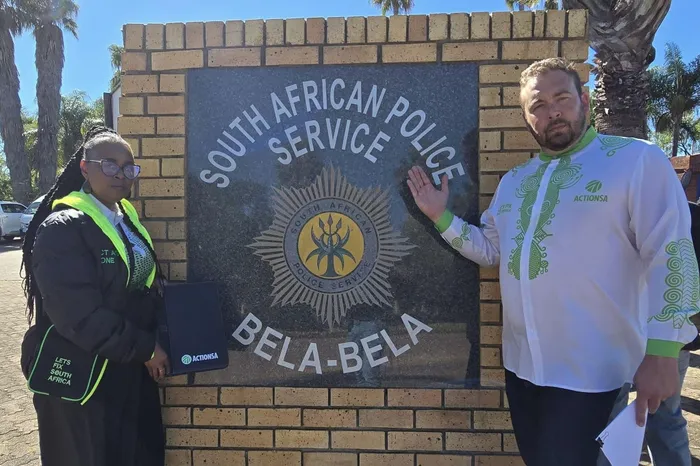
ActionSA national spokesperson Lerato Ngobeni and the party’s national chairman Michael Beaumont have laid criminal charges against President Cyril Ramaphosa over the Phala Phala scandal.
Image: Facebook/Michael Beaumont
Opposition party ActionSA says it believes the time has come for President Cyril Ramaphosa to account for the Phala Phala farm scandal and has laid criminal charges against him for allegedly lying about the amount of money stolen from his Limpopo farm in 2020.
This comes after recent media reports suggested that the money stolen totalled R15 million, and not R10 million as previously stated.
The party laid criminal charges at the Bela Bela police station in Limpopo on Wednesday.
“ActionSA can confirm that it has today laid criminal charges against President Cyril Ramaphosa in relation to the Phala Phala matter,” said the party’s national spokesperson, Lerato Ngobeni.
She said the charges relate to the alleged contravention of Section 34(1)(b) of the Prevention and Combating of Corrupt Activities Act 12 of 2004 (PRECCA), perjury and fraud.
Ngobeni said the charges arose from serious concerns regarding the alleged concealment and under-disclosure of the true amount of money stolen during the burglary at Ramaphosa’s farm.
“According to information now in the public domain, the amount allegedly stolen may have been significantly higher than what has previously been disclosed publicly, with reports placing the value at no less than R15 million, substantially above the widely cited figure of approximately USD580,000, or roughly R8.75 million at the prevailing exchange rate at the time of the burglary.
“ActionSA further notes with serious concern reports that cash flow analyses conducted by the National Prosecuting Authority (NPA) on one of the accused implicated in the Phala Phala burglary have already raised questions regarding the true extent of the funds involved,” she said.
According to Ngobeni, should similar analyses be conducted in respect of the remaining accused, South Africans may well be confronted with an even more disturbing picture regarding the scale of the funds connected to the matter and the transactions surrounding it.
“These developments reinforce ActionSA’s long-standing view that the South African public has not been told the full truth about Phala Phala.
“Section 34 of PRECCA imposes a clear legal obligation on persons in positions of authority to report corruption and related offences involving amounts above the prescribed threshold. Any deliberate failure to accurately disclose material information relating to such offences raises serious legal and constitutional concerns.”
She said, “Similarly, statements made under oath must be truthful, complete, and accurate.
“Where material facts are intentionally misrepresented or concealed under oath, this may constitute perjury.
“ActionSA also believes that any deliberate misrepresentation regarding the amount stolen — particularly where such conduct may have had the effect of obscuring the true nature or extent of the offence under investigation - may amount to fraud and undermine the integrity of the criminal justice process itself.”
She said South Africa could not continue down a path where accountability depended on political status or public office.
“The rule of law must apply equally to all, including the President of the Republic. The Presidency cannot become insulated from scrutiny simply because accountability becomes politically inconvenient.
“South Africans deserve the truth, and the institutions tasked with uncovering that truth must be allowed to function freely, independently, and without fear, favour, or political interference.”
Ngobeni said the matter extended far beyond one individual.
“It strikes at the heart of constitutional governance, public trust in the Presidency, and confidence in the integrity of state institutions.
“ActionSA will continue pursuing accountability through all lawful constitutional mechanisms available and will continue insisting that the criminal justice system be allowed to process this matter independently and without interference.
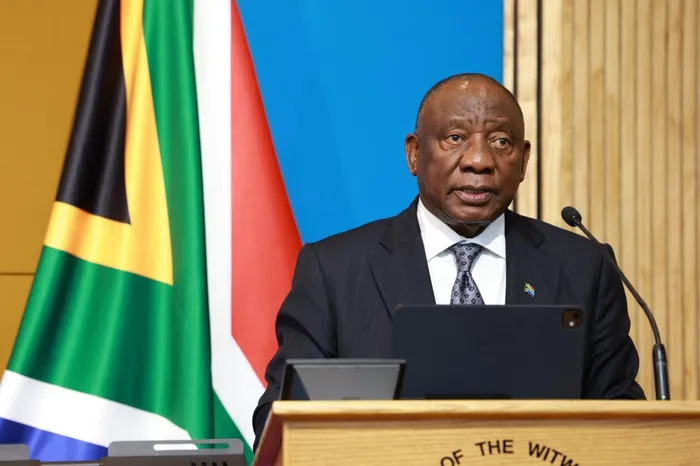
ActionSA says new reports suggesting up to R15 million was stolen from the President Cyril Ramaphosa’s farm raise serious questions about alleged under-disclosure and accountability.
Image: GCIS
“South Africans deserve honesty, transparency, and accountability, especially from the highest office in the Republic,” she added.
This comes as Ramaphosa plans a legal challenge to the Section 89 independent panel report over the Phala Phala scandal.
Ramaphosa announced on Monday night that, following advice from his legal team, he would take the report of the panel chaired by former chief justice Sandile Ngcobo on judicial review.
Last Friday, the apex court paved the way for a public impeachment hearing into Ramaphosa’s conduct in the Phala Phala saga.
On Monday, National Assembly Speaker Thoko Didiza confirmed that Parliament would establish an impeachment committee into the report chaired by Ngcobo.
The apex court ruled that Rule 129I of the National Assembly’s rules was unconstitutional and invalid.
It also overturned the National Assembly’s December 2022 decision not to send the Section 89 panel report on Ramaphosa’s conduct in the Phala Phala matter to an impeachment committee.
The panel found that Ramaphosa had questions to answer over the theft of $580,000 hidden in a sofa at his Phala Phala farm in Limpopo in February 2020.
The Constitutional Court ordered that the report be referred to an impeachment committee.
Ramaphosa has denied any wrongdoing related to the Phala Phala saga and maintained that the report was “flawed”.
He also said he would not resign following calls from political parties to step down.
Ealier, IOL News reported that constitutional experts said Ramaphosa’s intention to launch a review application of the Section 89 panel report in relation to the Phala Phala saga was likely to be “difficult” one.
Senior lecturer at the Wits School of Law, Dr Shadi Maganoe, responded to IOL News inquiries.
“It would likely be difficult,” she said.
“Courts are generally cautious about interfering in parliamentary internal processes, including their accountability procedures, especially at a preliminary stage.
“The President would probably need to demonstrate procedural unfairness, irrationality, factual errors or that the panel exceeded its mandate, therefore arguing the principle of legality as well. Mere disagreement with the panel’s conclusions is unlikely to be enough.”
IOL Politics