

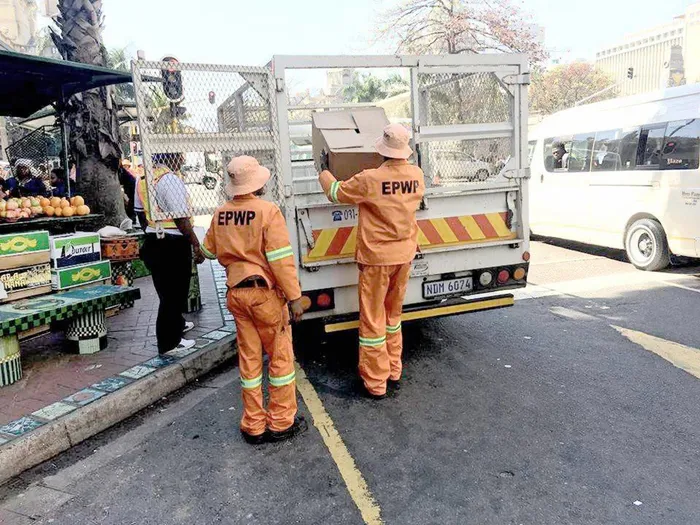
Minister Dean Macpherson has addressed the urgent need for reform in the Expanded Public Works Programme.
Image: Independent Newspapers
The Expanded Public Works Programme (EPWP) faces an integrity crisis due to widespread abuse, which the Department of Public Works and Infrastructure (DPWI) admits is rife with non-transparent recruitment, inadequate verification, and administrative weaknesses.
These flaws facilitate manipulation, patronage, and theft, often by ward councillors controlling beneficiary lists. Sweeping reforms, prioritising robust digital systems over flawed human control, are immediately necessary, the department said.
DPWI Minister Dean Macpherson said eThekwini’s case reinforces why the ministry has embarked on wider EPWP reform.
“For too long, weaknesses in administration at implementing public bodies, opaque recruitment processes, and weak verification systems have left the programme vulnerable to manipulation. That must end,” Macpherson said on Tuesday.
“We are working to modernise the programme through stronger digital systems, better verification processes, and real-time oversight tools that reduce the space for abuse by corrupt officials.”
Macpherson said the EPWP should work for the 'unemployed queuing up for an honest opportunity, and not for the politically connected, ghost names on a spreadsheet, and those who see public employment programmes as vehicles for patronage and theft'.
He said that during their recent roadshow across the country for the EPWP listening tour, they heard communities complain about 'how the programme is used by ward councillors because they are the ones who compile the lists, to promote patronage and political opportunity'.
“Our view is that one of the big problems with EPWP is that it rests at the ward councillors’ door. And we have heard stories of how membership cards have to be produced, how money has to be produced, or how, even worse, opportunities are pooled so that people get paid R10,000 - R20,000. Those are being taken away from a whole group of people and only being allocated to a single person,” Macpherson said.
He said they have to remove the human hand in EPWP, as that is where the opportunity for abuse is.
“That’s why we are dead set on a digital interface between applicants and the department or the province, municipality, whatever that may be, because then you can actually verify through technology the existence of the individual, the ID number of the individual,” Macpherson said.
“I guess that that’s going to make me pretty unpopular in local government, but my focus is on the people who need this programme, who look to this programme to advance their daily reality. We’re okay with that unpopularity because we must eliminate all opportunity for abuse in the system.”
Macpherson said it is their responsibility to restore the EPWP’s credibility, ensure that every rand meant for the poor reaches the poor, and ensure that those who abuse the programme face consequences.
Similarly, KZN DPWI MEC Martin Meyer said the department’s citizens’ engagement roadshow for EPWP, was the number one concern. Complaints included participants having to prove political party affiliation, pay for jobs, sex for jobs and jobs for people with relationships with officials.
This led the department to launch its EPWP anti-fraud and whistleblower portal.
Meyer added that as a turnaround intervention, the department will be reviewing certain parts of the EPWP.
These include: